Journal · Explainer · 4 min read
Graphene batteries: hype vs reality
The word on the box is graphene. The cell inside is almost always lithium-ion.
A power bank box says graphene in large letters, and the price is higher than the one beside it. Graphene won a Nobel Prize. Does that mean the battery inside is a new kind of battery?
Short answerAlmost never. Products sold as graphene batteries are, in nearly every case, lithium-ion cells with some graphene added, often as a conductive additive in an electrode or as a layer that spreads heat. That can help with heat and charging. It is not a new chemistry, so judge the product by its watt-hours, cycle rating and heat, not the word.
The numbers: what graphene really is
Graphene is a single layer of carbon atoms, isolated in 2004 by Andre Geim and Konstantin Novoselov at the University of Manchester using adhesive tape, work that won the 2010 Nobel Prize in Physics, according to Wikipedia's summary of the research.
Its properties are remarkable on paper. Wikipedia lists room-temperature electron mobility above 15,000 cm² per volt-second and intrinsic tensile strength of about 130 GPa. Early measurements of thermal conductivity in suspended graphene reached up to 5,300 W/m·K, but later studies of single-layer graphene grown by chemical vapour deposition, the method used at scale, gave 1,500 to 2,500 W/m·K, and on a substrate around 500 to 600 W/m·K. Sources disagree, and the lower figures are closer to what ends up in products.
Scale is the catch. Wikipedia notes that making small amounts is easy, but mass production has had limited success because of cost and quality-control problems.
| Type of graphene | Thermal conductivity |
|---|---|
| Suspended, early measurements | Up to 5,300 W/m·K |
| Single layer, grown by CVD | 1,500 to 2,500 W/m·K |
| CVD graphene on a substrate | About 500 to 600 W/m·K |
Source: Graphene, Wikipedia
What the research has shown
Most of the dramatic results come from laboratories. Wikipedia's survey of graphene applications lists a 2012 demonstration of silicon-graphene anodes for lithium-ion cells, a 2014 graphene-and-silicon cell claimed to charge in about 15 minutes, and supercapacitor prototypes, which store charge on surfaces rather than in chemistry, with energy densities of about 22 to 42 Wh/L in one 2015 design. These are prototype figures and claims, not commercial specifications.
For comparison, ordinary lithium-ion cells store far more energy for their size. That is why graphene supercapacitors have not replaced phone batteries: they charge very fast but hold much less.
In industry, Huawei announced graphene-assisted lithium-ion batteries in 2016 with better heat tolerance and, it said, about double the lifespan. Battery University's review of future batteries mentions graphene only in trials of lithium-sulphur cathodes, with promising results but no figures.
How graphene helps inside a lithium-ion cell
A lithium-ion cell stores energy by moving lithium ions between a graphite anode and a metal-oxide cathode. The electrodes are made from powders bound together, and electrons must find a path through them. Additives improve those paths. Graphene, being very thin and very conductive, can do this with small amounts, which can lower internal resistance, reduce heat and help a cell accept charge a little faster.
Graphene films are also used to spread heat away from hot spots. Because its in-plane thermal conductivity is high, a thin sheet can move heat sideways across a device so that no single spot gets as hot.
Think of it like a pinch of saffron in a pot of biryani. It changes the dish, and the menu may name it, but the dish is still rice. A graphene-enhanced battery is still a lithium-ion battery, with the same limits on energy, safety and ageing.
Where the marketing outruns the chemistry
The word graphene has no fixed meaning on a label. A cell with a trace of graphene additive, a pack with a graphene heat-spreading sheet, and a hypothetical all-new graphene chemistry can all be called graphene batteries. Only the first two are on sale in quantity.
So a graphene power bank does not automatically hold more energy, survive more cycles or charge faster. Those depend on the cell design, the charging circuit and the cooling. If a maker claims a benefit, it should give the number.
What to check before you buy
Read the rated energy in Wh, not only mAh. Two power banks with the same mAh can deliver different usable energy. Watt-hours also decide whether a power bank is allowed on a flight.
Ask for the cycle rating. A real improvement should show up as a stated number of cycles to a given capacity, for example 80 percent.
Check the output, not the chemistry. Charging speed for your phone depends on USB Power Delivery support and wattage, not on graphene.
Feel the heat claim in practice. If graphene is sold as a cooling benefit, the pack should stay noticeably cooler during a long fast charge.
Look for the BIS registration number on the label and check it on the Bureau of Indian Standards Compulsory Registration Scheme portal, which also publishes guidelines for verifying the rated capacity of portable lithium cells and batteries.
Myth corner
Myth: graphene batteries charge in seconds. That claim comes from supercapacitor research, which stores far less energy than a lithium-ion cell. Wikipedia's survey of the field lists supercapacitor prototypes, not phone batteries, behind the fastest results. Commercial graphene-enhanced cells still charge at lithium-ion speeds, limited by heat and the charger.
The right one for you
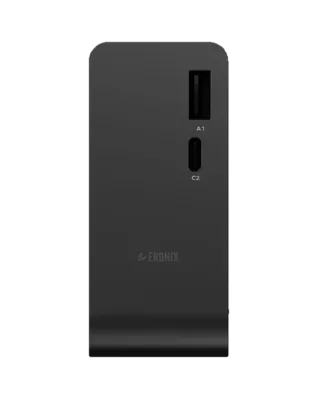
This guide asked for the energy in watt-hours, not a material on the box. The Battery Pack for MacBook 140W states it plainly: 20,000 mAh and 74 Wh, under the cabin limit for flights.
It gives 140 W, enough for a MacBook Pro at full speed and a phone or iPad in turn, and a display shows what is left, so you judge it by the numbers rather than the label.
Step by step
- Read the energy rating in Wh on the power bank label.
- Check the output wattage and USB Power Delivery support for your phone.
- Ask the seller for the cycle rating to a stated capacity.
- Look for a BIS registration number on the product.
- Test whether the pack stays cool during a long fast charge.
Questions people ask
Is a graphene power bank better than a normal one?
Not automatically. Most graphene power banks use lithium-ion cells with graphene added as a conductive additive or heat spreader. That can reduce heat slightly, but capacity, output and cycle life depend on the cells and circuits. Compare watt-hours, output wattage and cycle rating rather than the label.
Do graphene batteries exist in phones?
Phones use lithium-ion or lithium-polymer cells. Some makers have announced graphene-assisted cells or use graphene films for cooling; Huawei announced graphene-assisted batteries with better heat tolerance in 2016. A phone battery made mainly of graphene is not on sale, based on the sources reviewed.
Why is graphene used for cooling phones?
Graphene conducts heat very well along its plane. Wikipedia reports 1,500 to 2,500 W/m·K for graphene grown at scale, though values fall on a substrate. A thin graphene film can spread heat sideways from a hot chip or battery so no single spot gets as hot.
Are graphene batteries safer than lithium-ion?
A graphene-enhanced battery is still a lithium-ion battery, so it has similar safety needs: a protection circuit, good cells and sensible charging. Better heat spreading can help, but it does not change the flammable electrolyte. Check the BIS registration number on the BIS CRS portal and buy from a maker you can contact, as with any power bank.
Sources
- Graphene, Wikipedia · accessed 22 Nov 2026
- Potential applications of graphene, Wikipedia · accessed 22 Nov 2026
- BU-212: Future batteries (Battery University) · accessed 22 Nov 2026
- BIS Compulsory Registration Scheme portal (Bureau of Indian Standards) · accessed 22 Nov 2026
Battery Management
Capacity is chemistry; longevity is software.
Read →Explainer · 4 min readDoes fast charging kill the battery?
The watts on the charger matter less than the temperature of the phone
Read →Explainer · 4 min readLithium-ion vs lithium-polymer cells
Two names on power bank boxes, one chemistry inside. The real difference is the packaging.
Read →Explainer · 4 min readHow to store a power bank you rarely use
The emergency power bank is only useful if it still works on the day of the emergency.
Read →Explainer · 5 min readSolid-state batteries: what they could change
The battery everyone keeps promising. What is real today, and what is still a lab result.
Read →Explainer · 5 min readCan a 100 W charger damage your phone?
The watts on the brick are a ceiling, not a push. Heat is what your battery remembers.
Read →