Journal · Explainer · 5 min read
How chargers are tested before they ship
From prototype to the last unit off the line, each stage asks a different question.
Somewhere a charger is being deliberately overloaded, shorted, heated and zapped with thousands of volts, so that the one on your bedside table never has to survive any of that unprepared. Who does this testing, what are they looking for, and how much of it happens to the unit you actually buy?
Short answerTesting happens in three layers. The design is tested against electrical safety standards and, for USB products, compliance programmes such as USB-IF's. Regulators such as BIS require registration based on lab test reports. Then every unit on the production line gets quick checks, typically an insulation test and an output test, before packing.
Layer one: testing the design
Before a charger goes into production, samples are sent to a test lab and examined against a product safety standard for audio, video and IT equipment. Modern standards in this family are hazard-based: they ask where dangerous energy exists inside the product, such as mains voltage or heat, and check that enough independent safeguards stand between that energy and the user.
In practice, that means a long list of checks. Lab engineers measure how hot every component and surface gets at full load. They test what happens when parts fail on purpose, such as a shorted output or a blocked vent. They check the gaps and insulation between the mains side and the USB side, and they apply high voltage across that barrier.
That high-voltage check is the dielectric withstand test, often called a hipot test. Reference sources describe it as applying a set voltage across insulation and passing the part only if leakage current stays below a limit. The voltage and duration come from the product's standard; reference sources describe tests as normally lasting up to five minutes.
| Layer | Who does it | What it checks |
|---|---|---|
| Design | Test lab, against a safety standard | Heat, fault behaviour, insulation, hipot |
| Compliance and registration | USB-IF programme; BIS registration | Test IDs, Integrators List; Standard Mark |
| Production line | The factory, on every unit | Quick hipot, output and protocol checks |
Source: USB-IF compliance program; BIS and Hipot, Wikipedia, accessed 22 Nov 2026
Layer two: compliance and registration
USB chargers that want to carry USB-IF logos must pass the USB Implementers Forum's compliance programme. The USB-IF describes test specifications, each tracked by a Test ID, run either at authorised independent test labs or at member compliance workshops held about once a quarter, typically over five days. Passing products are listed on the USB-IF's Integrators List, and may then use the logos under a trademark licence agreement.
The USB-IF also runs qualification by similarity, where a closely related product may be listed without retesting, but a compliance review board decides when differences are significant enough to need their own tests.
In India, BIS operates a Compulsory Registration Scheme under which its Standard Mark is required for certain types of electronics and IT goods. BIS also runs a laboratory recognition scheme for the labs that test products. Foreign manufacturers must appoint an authorised Indian representative who is an Indian resident.
Layer three: testing on the production line
Design tests prove the blueprint. Production tests prove each copy. On a typical charger line, every finished unit is plugged into automated test stations. One applies high voltage across the isolation barrier for a short time to catch a pinched wire or misplaced part. Another loads the output at different voltages and currents to check regulation, ripple and protocol behaviour, such as whether the USB PD handshake offers the right profiles.
Many factories add a burn-in stage, running units under load for a period to catch early failures before they leave the building. Samples from each batch may also be pulled for longer tests, which is the subject of batch quality control.
Think of it like a restaurant. The recipe is tested once in the development kitchen. Then every plate is checked at the pass before it goes to a table. A good kitchen does both; a bad one tests the recipe and hopes for the rest.
What independent labs add
Labs such as ChargerLAB buy products and open them up, documenting every part and testing output with protocol analysers. Their teardowns show what a sound design looks like inside: input fuses, inrush limiters, filters, isolation components and thermal cut-offs. Such independent checks often catch products whose inside does not match the claims on the box.
Why testing never really stops
Testing continues after a charger ships. Makers track returns and field failures, and a pattern in one batch can trigger re-testing of samples held back from that batch. Component suppliers change, and a good maker retests when a key part such as a capacitor, transformer or switch is substituted.
Firmware is part of this too. Protocol chips that negotiate USB PD can receive updates during production, and each change needs checking against the phones and laptops the charger is meant to serve. That is why the same model can behave slightly differently between early and later production runs.
What to check before you buy
Look for the BIS Standard Mark and a registration number on the charger or box.
If a USB-IF logo is shown, the product should appear on the USB-IF's Integrators List.
Check the label for a maker name, address and a detailed output table. Tested products are labelled precisely.
Read independent teardowns or lab tests when they exist for a charger you are considering.
Be wary of unusually light high-wattage chargers with no markings.
Myth corner
Myth: if a charger has a logo, every unit was lab tested. Logos and registrations rest on testing of the design and samples. Each individual unit is protected by the factory's production-line checks. Both layers matter, which is why the maker's own quality process counts as much as the mark.
The right one for you
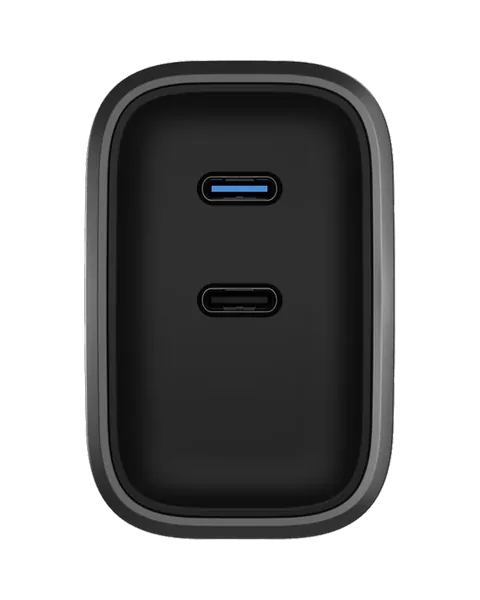
Precise labelling is the part of this process a buyer can check, and the Fermi45 states it in full: every fixed rail from 5 V 3 A to 20 V 2.25 A, PPS from 5 to 20 V at 3 A, a 100–240 V input, and over-voltage, over-current, over-temperature and short-circuit protection. It is the charger for iPhone 17 and the Galaxy S phones that take 45 W, in a GaN3 body of 62.5 × 42 × 36 mm.
Questions people ask
What is a hipot test on a charger?
A hipot or dielectric withstand test applies a high voltage across the insulation between a charger's mains side and its low-voltage side. The charger passes only if leakage current stays under a set limit. The test voltage and duration are set by the product's safety standard.
Is every charger tested before it leaves the factory?
In a well-run factory, yes: each unit typically goes through automated insulation and output tests on the line. Design-level safety testing and certifications, by contrast, are done on samples. Good quality depends on both layers working together.
What does USB-IF compliance mean?
It means the product passed the USB Implementers Forum's compliance tests, run at authorised labs or quarterly member workshops. Passing products are listed on the USB-IF Integrators List and may use USB-IF logos under a trademark licence agreement.
Do chargers sold in India need BIS registration?
BIS operates a Compulsory Registration Scheme under which its Standard Mark is required for certain categories of electronics and IT goods. BIS also recognises the laboratories that carry out product testing. Check the charger and box for the mark and a registration number.
What is burn-in testing?
Burn-in means running products under load for a period before shipping so that units with weak components fail at the factory rather than at home. It is commonly used in electronics manufacturing; its length and conditions vary from maker to maker.
Sources
- Compliance program, USB Implementers Forum · accessed 22 Nov 2026
- Hipot (dielectric withstand test), Wikipedia · accessed 22 Nov 2026
- Bureau of Indian Standards, Wikipedia (Compulsory Registration Scheme) · accessed 22 Nov 2026
- Teardown of a 100 W GaN charger with retractable USB-C cable, ChargerLAB · accessed 22 Nov 2026
GaN — Gallium Nitride
The semiconductor that let chargers shrink.
Read →Explainer · 4 min readHotel room charging: making one socket work
One socket behind the bed, three devices, a 7 am meeting. Here is the plan.
Read →Explainer · 5 min readGaN chargers: what changed and what did not
A new material shrank the charger. Your phone's charging speed stayed where it was.
Read →Explainer · 4 min readWhat happens inside a charger when you plug it in
Between the wall and your phone, a charger does six jobs in a box you can close a fist on.
Read →Explainer · 5 min readHow to charge two laptops from one charger
In one lab test, a 65 W charger gave the second laptop 0 W. Here is how to avoid it.
Read →Explainer · 4 min readHow to know a charger's real output
The box says 100 W. Over half an hour, some chargers quietly deliver much less.
Read →