Journal · Explainer · 4 min read
How to read the watts your phone is getting
A meter the size of a matchbox turns charging from a guess into a reading.
Every charger promises a number, and every phone keeps its real number to itself. The lightning bolt on the screen looks the same at 5 W and at 45 W. If you want to know what is actually flowing, you have to measure it, and that is easier than it sounds.
Short answerPlug a small inline USB-C power meter between the charger and the cable, or the cable and the phone. It shows volts, amps and watts live. Watts are volts times amps, so 9 V at 3 A is 27 W. Read it in the first minutes from a low battery, when phones draw the most.
What the professionals read
Independent charging labs report in exactly these three numbers. ChargerLAB's test of a Galaxy S24 Ultra, for example, logged a 45 W charger delivering 41.5 W at 9.16 V and 4.53 A, and a 140 W laptop charger from another maker delivering 22.35 W at 8.62 V and 2.59 A. The voltage and current explain the gap: both ran near 9 V, but only the first supplied the 4 A-plus current that phone wants.
Notebookcheck's iPhone 17 test shows the same kind of reading over time. On Apple's 40 W adapter, the phone negotiated 15 V, peaked at about 36 W, held about 28 W for 11 minutes and fell to about 8 W by 57 minutes. On the 20 W adapter, it ran at 9 V and drew about 19 W for the first 36 minutes.
Tom's Hardware's test of 20 wall chargers used a Power-Z KM003C USB tester to read volts, amps, watts and protocol. That class of tester, a small inline meter, is what a curious buyer can use at home.
| Setup | Volts | Amps | Watts |
|---|---|---|---|
| Galaxy S24 Ultra, 45 W charger | 9.16 V | 4.53 A | 41.5 W |
| Galaxy S24 Ultra, 140 W laptop charger | 8.62 V | 2.59 A | 22.35 W |
| iPhone 17, 40 W adapter (peak) | 15 V | Not published | About 36 W |
| iPhone 17, 20 W adapter | 9 V | Not published | About 19 W |
Source: ChargerLAB; Notebookcheck, accessed 22 Nov 2026
Step by step with an inline meter
Step one: let the phone drop below about 20%. The first minutes of charging are where peak power appears.
Step two: connect charger, meter, cable and phone in that order, or charger, cable, meter, phone. Both work; the second includes the cable's losses in what the phone sees.
Step three: watch the meter for one to two minutes. Note the voltage, current and watts once they settle. Many meters also show the protocol, such as PD or PPS, and the voltage options the charger offered.
Step four: keep the screen off and the phone still. Using the phone adds load and heat, and both change the reading.
Step five: check again at 50% and 80%. A falling number is normal, not a fault.
How it works: volts are pressure, amps are flow
Power in watts is voltage multiplied by current. Voltage is like water pressure in a pipe, current is how much water moves each second, and watts are the work done. A phone can get 27 W at 9 V and 3 A, or at 15 V and 1.8 A; the work is the same.
USB Power Delivery lets the phone pick a voltage and current from the charger's menu. Raising the voltage lets the same cable carry more power without pushing its current limit, which is why iPhones on 40 W adapters use 15 V while Galaxy phones often run near 9 V with higher current through a 5 A cable.
Think of it like a tanker lorry delivering water to a building. You can send a small tanker many times or a big one fewer times. What matters is the litres delivered per hour. A meter counts both the size of the tanker and the number of trips.
Without a meter: two rough methods
Chargers with displays. Some chargers show output watts on a small screen. They are useful for a quick read, though Tom's Hardware found displays raise idle power to about 1 W.
The clock method. Note the battery percentage change over 10 minutes from a low level. Compare it with the maker's fast-charge claim, such as Apple's 50% in about 20 minutes for the iPhone 17. It will not give watts, but it tells you whether you are near the intended speed.
What to check before you buy
Check that a USB-C meter supports the power you need. A meter limited to 3 A or 20 V cannot read a 5 A or 140 W setup.
Check that it shows protocol information. Knowing whether PD or PPS is active explains most slow-charging puzzles.
Check the charger's own sharing table if you test a multi-port charger. Reading one port alone and then with a second device plugged in shows how it splits power.
Check readings against a maker's figure, not another person's video. Phone software, temperature and battery level all change the result.
Myth corner
Myth: if the charger says 65 W, the phone is getting 65 W. The label is the maximum on offer. In ChargerLAB's test, a 65 W charger delivered about 44 W to a Galaxy S24 Ultra, because that is what the phone asked for. The meter shows the request, not the promise.
The right one for you
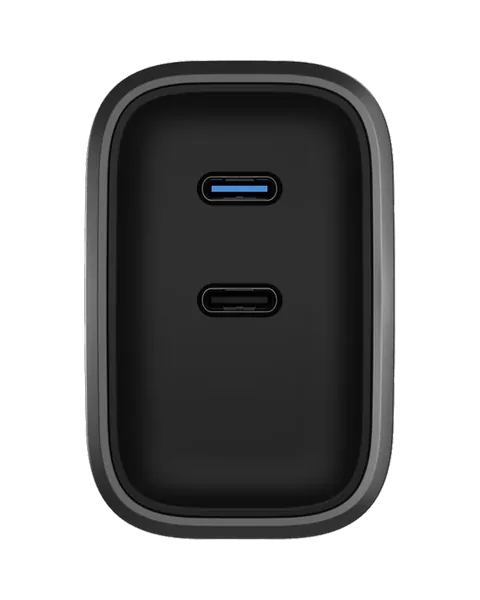
A meter reading makes most sense against a charger that prints its menu. The Fermi45 lists every rail, 5 V 3 A, 9 V 3 A, 12 V 3 A, 15 V 3 A and 20 V 2.25 A, plus PPS from 5 to 20 V, so you can see which one the phone chose.
On an iPhone 17 the meter shows the 15 V step; on a 45 W Galaxy, Samsung Super Fast Charging 2.0 delivers 45 W from one port at 4.5 to 4.8 A.
Step by step
- Let the phone's battery drop below about 20%.
- Connect the USB-C meter between the charger and the phone's cable.
- Watch the volts, amps and watts for one to two minutes with the screen off.
- Note the protocol shown, such as PD or PPS.
- Repeat at 50% and 80% to see how power falls as the battery fills.
Questions people ask
Are USB-C power meters accurate?
Good ones are accurate enough to compare chargers and confirm fast-charging modes, and labs such as Tom's Hardware use inline USB testers in their reviews. Any meter adds a short extra connection, and accuracy varies between models. Use the same meter for all comparisons, and focus on large differences rather than fractions of a watt.
Why does my phone charge at lower watts than the charger's rating?
The phone sets the power, not the charger. It asks for what its battery and temperature allow and lowers the request as it fills. ChargerLAB measured a 65 W charger delivering about 44 W to a Galaxy S24 Ultra, and Notebookcheck saw an iPhone 17 peak near 36 W on a 40 W adapter.
Can an app show my phone's charging watts?
Some Android apps estimate charging current from the phone's battery sensor and calculate watts. They are useful for trends but depend on how each phone reports current, and some phones report poorly. An inline USB-C meter measures the power directly and works the same way for every phone.
What voltage does fast charging use?
It varies by phone. Under USB Power Delivery, fixed options include 5 V, 9 V, 15 V and 20 V. Notebookcheck found an iPhone 17 using 15 V on a 40 W adapter and 9 V on a 20 W one. Galaxy phones using PPS adjust in fine steps, often near 9 V with higher current.
Sources
- 45W compatibility test of Samsung Galaxy S24 Ultra (ChargerLAB) · accessed 22 Nov 2026
- iPhone 17 charging test shows negligible improvement with Apple's new 40 W charger (Notebookcheck) · accessed 22 Nov 2026
- We tested 20 wall chargers from 15 W to 140 W (Tom's Hardware) · accessed 22 Nov 2026
- Fast charge your iPhone (Apple Support) · accessed 22 Nov 2026
- Cable and adapter tips and tricks (ChromiumOS developer library) · accessed 22 Nov 2026
USB-C Power Delivery
One connector, a negotiated contract.
Read →Explainer · 5 min readUSB Power Delivery explained in one page
How a charger and a phone agree on power before it flows, and how to read the label.
Read →Explainer · 5 min readPPS: why Samsung phones care about it
Three letters on a charger label decide whether a Galaxy charges at full speed or half.
Read →Explainer · 4 min readCan you use a Samsung charger on an iPhone?
Different logos, same plug, shared standard. What decides the speed is two letters: PD.
Read →Explainer · 4 min readDo original chargers matter?
The logo on the plug matters less than two words in its small print.
Read →Explainer · 4 min readHow to check if your phone is fast charging
No meter needed. A clock, a low battery and the maker's own claim tell you most of it.
Read →