Journal · Explainer · 4 min read
Why do chargers have different plug shapes?
Fifteen plug shapes, one reason: nobody agreed in time. What that means for you.
The IEC counts 15 plug types, A to O, and India uses two of them. So a relative brings you a charger from abroad, and its pins are flat, or round but too thin, or there are three of them in a shape your wall has never seen. The USB-C end fits your phone perfectly. Why can the world agree on a phone port but not on the plug at the other end?
Short answerMains plugs were standardised country by country, starting in the late 1800s, long before global trade in electronics. The IEC's guide now counts 15 letter types, A to O. India uses Type D for small devices and Type M for heavy appliances, at 230 V and 50 Hz. A dual-voltage charger needs only an adapter, not a converter.
The plug map in numbers
Wikipedia's article on AC plugs and sockets, which follows the IEC's lettering, lists 15 types from A to O, and warns that some letters cover several ratings or standards. Britain had two-pin plugs by 1885, three-pin earthed plugs by about 1910 and, in 1915, one of the first national plug standards.
India's main plug descends from that history. The round three-pin Type D was defined in Britain's BS 546 and introduced in 1934. Britain later moved to the fused, flat-pin Type G, but Type D remains in use in around 40 countries, including India. The same article links India's IS 1293 standard to Type D at 6 A and 250 V and Type M at 16 A and 250 V.
WorldStandards confirms the everyday picture: India runs at 230 V and 50 Hz, with Type D for small devices and chargers and Type M for refrigerators and washing machines. It adds that the two-pin Type C Europlug, common on imported gadgets, roughly fits Type D sockets but can be loose and sometimes unsafe.
There was an attempt at one plug. The IEC published IEC 60906-1 in 1986 as a common plug for 230 V regions, but its adoption as a European standard was put on hold in the mid-1990s. South Africa adopted it; Brazil built a similar plug that does not fully comply.
| Type | Rating or form | Where you meet it |
|---|---|---|
| Type D | 6 A, 250 V, round three-pin | India: small devices and chargers |
| Type M | 16 A, 250 V | India: refrigerators and washing machines |
| Type C (Europlug) | Two-pin | Imported gadgets; loose in Type D sockets |
| Type G | Fused, flat-pin | Britain |
Source: Wikipedia: AC power plugs and sockets; WorldStandards, accessed 22 Nov 2026
Why the shapes stayed different
Each country made its choices for good local reasons: its voltage, whether homes had earth wiring, whether sockets had shutters, and whether a fuse should sit in the plug, as in Britain's Type G. Once millions of sockets were installed in walls, changing the plug meant rewiring a nation. No country wanted to go first.
Phone ports escaped that trap because a phone lasts a few years, not decades, and regulators such as the EU pushed USB-C across all devices in one move. A wall socket can outlive three generations of phones.
Think of the side of the road a country drives on. Each choice made sense locally, and once every road, junction and car was built for it, switching became too costly. Plugs are the same: a historical choice set in concrete, literally, inside every wall.
What this means for chargers
The plug shape is only half the question; the voltage range is the other. Apple's travel adapter page says its power adapters accept 100 to 240 V at 50 to 60 Hz, and that plug adapters change only the shape, not the voltage or frequency. Most modern phone chargers are built the same way; the input range is printed on the label.
If a charger's label says 100-240 V, it works in India with a correctly fitting adapter or plug head. If it says 110-120 V only, it needs a voltage converter and is best left unused here.
Fit matters for safety. A loose plug can arc and heat up, which is why WorldStandards cautions against forcing Type C, E or F plugs into Indian Type D sockets.
USB-C helps more than it seems. Once the phone end is universal, a single charger with the right plug head, or one adapter, covers phone, tablet and laptop in most countries. The travel problem shrinks from a bag of chargers to one charger and the correct plug for the wall in front of you.
What to check before you buy
Read the input line on the charger label. You want 100-240 V and 50/60 Hz for travel and for imported chargers.
Check the plug type for India. A charger sold here should fit Type D sockets firmly without an adapter.
If you travel, prefer a charger with swappable plug heads or a well-made adapter, rather than forcing a plug.
Check the BIS registration number on chargers sold in India, and verify it on the BIS CRS portal.
Replace any adapter that wobbles in the socket or gets warm at the pins.
Myth corner
Myth: a travel adapter converts voltage, so any foreign charger is safe with one. Apple notes that plug adapters change only the shape. A 120 V-only device on Indian 230 V mains through a simple adapter can be damaged; check that the charger itself is rated 100-240 V.
The right one for you
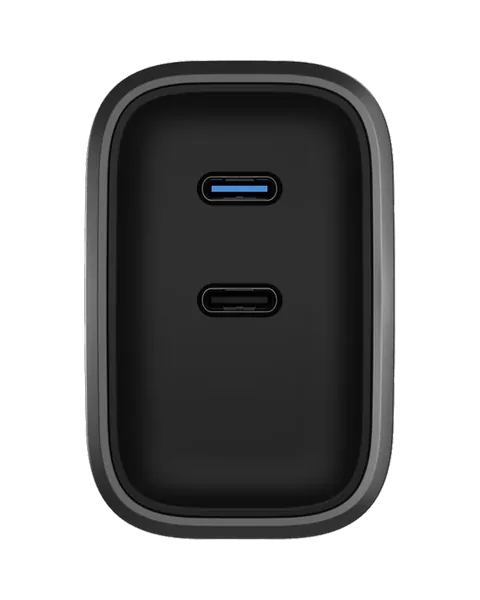
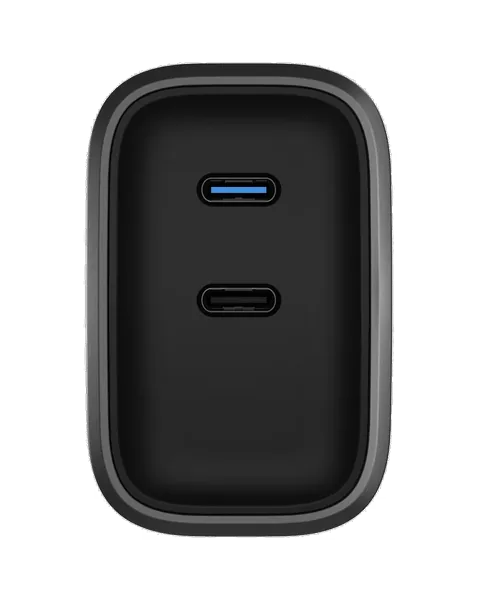
The label decides more than the plug. The Fermi45 states its input as 100 to 240 V at 50 to 60 Hz, the range that works on Indian mains and abroad, and gives 45 W for an iPhone 17 or a 45 W Galaxy S.
For travel, the Travel Charger 65 W carries IN, UK, EU and US plug heads in a leather pouch, with a 240 W USB-C cable, so one charger meets the wall in front of you, MacBook and iPhone included.
Step by step
- Read the input range printed on the charger label.
- Confirm it says 100-240 V, 50/60 Hz.
- Use a plug head or adapter that fits the local socket firmly.
- Avoid forcing loose or mismatched plugs into sockets.
- Replace adapters that wobble or get warm.
Questions people ask
Which plug type does India use?
India uses Type D, three round pins in a triangle, for small devices and chargers, and the larger Type M for heavy appliances. Mains supply is 230 V at 50 Hz. Some Indian homes have combined sockets that accept both D and M plugs, according to WorldStandards.
Can I use a European two-pin charger in India?
If the charger is rated 100-240 V, it will work electrically, but the two-pin Type C plug fits Indian Type D sockets only loosely, which WorldStandards describes as sometimes unsafe. Use a proper adapter or a plug head made for Indian sockets rather than forcing it in.
Do I need a voltage converter for my phone charger abroad?
Usually not. Most phone and laptop chargers, including Apple's, accept 100 to 240 V and 50 to 60 Hz, so a plug adapter is enough. Check the input range on the label. If it lists only 110-120 V or only 220-240 V, you may need a converter.
Why does a UK plug have a fuse?
The British Type G plug carries its own fuse inside the plug body, so a fault in the appliance or its cord blows the plug's fuse first. It is one example of a local safety choice that, once built into millions of homes, made a single world plug much harder to agree on.
Sources
- Wikipedia: AC power plugs and sockets · accessed 22 Nov 2026
- WorldStandards: India plug, socket and voltage · accessed 22 Nov 2026
- Apple Support: About the Apple World Travel Adapter Kit · accessed 22 Nov 2026
- European Parliament Legislative Train: Common chargers for mobile phones and similar devices · accessed 22 Nov 2026
USB-C Power Delivery
One connector, a negotiated contract.
Read →Explainer · 4 min readThe one-charger travel kit
Laptop, phone, earbuds and watch from one socket. The sum to do before you pack.
Read →Explainer · 5 min readHow to choose the right charger in 30 seconds
Four questions, asked in order, cut a wall of chargers down to two or three.
Read →Explainer · 5 min readHow chargers are tested before they ship
From prototype to the last unit off the line, each stage asks a different question.
Read →Explainer · 5 min readWhy India's charger market is changing
No charger in the box, one port for everything, stricter rules. What it means for buyers.
Read →Explainer · 4 min readWhy premium accessories cost more: materials and testing
Two chargers can look identical. The difference is in parts and tests you never see.
Read →