Journal · Explainer · 4 min read
Why premium accessories cost more: materials and testing
Two chargers can look identical. The difference is in parts and tests you never see.
On a roadside stall, a charger that looks almost exactly like a branded one sells for a fraction of the price. Open one copy up, as engineer Ken Shirriff did, and the gap between mains and the part you touch can be under 1 mm where 4 mm is called for. So is a premium price a logo tax, or something real inside?
Short answerThere is usually something real, and most of it is invisible. Better chargers spend on safety distance between high and low voltage, insulation, protection circuits, output filtering, quality capacitors and semiconductors, and on testing against USB and safety standards. These add cost without changing how the charger looks.
What a teardown reveals
Engineer Ken Shirriff's teardown of a counterfeit 45 W laptop charger shows where corners get cut. He notes that the recommended separation between the mains side and the low-voltage side is at least 4 mm. In the fake, the gap near the optoisolator was under 1 mm, and the heat sink bridged both sides with only small gaps. The genuine charger used extensive insulating tape; the copy used heat-shrink only around the fuse.
Protection was missing too. Shirriff found the counterfeit lacked the small controller that keeps the connector at a safe low voltage until a laptop is detected. It put out full voltage, about 14.75 V, at all times and sparked when its pins were shorted.
Power quality suffered. Drawing about 15 W, the fake's output showed spikes of about 2.7 V peak to peak at around 60 kHz from its switching. More filtering would have removed them, he observes, but would have cost more. The genuine charger, by contrast, was packed with parts and several chips.
| Feature | Recommended or genuine | Counterfeit |
|---|---|---|
| Mains to low-voltage gap | At least 4 mm | Under 1 mm |
| Insulation | Extensive tape | Heat-shrink round the fuse only |
| Safe-voltage controller | Present | Missing; about 14.75 V at all times |
| Output spikes at about 15 W | Not reported | About 2.7 V peak to peak |
Source: Ken Shirriff's blog, March 2016
Efficiency (%)
Source: IEA 4E PECTA, March 2024
Where the money goes inside a good charger
Isolation and creepage. The gap between the mains side and the part you touch is the most important safety feature of any charger. Keeping it wide, insulated and taped takes board space and careful layout, which is harder in a small case.
Protection circuits. Over-voltage, over-current, short-circuit and over-temperature protection each need parts. A USB Power Delivery charger also needs a controller that negotiates voltage with the device and starts at a safe 5 V.
Better switching parts. Gallium nitride transistors cost more than silicon. The IEA's 2024 measurements found GaN chargers in the 60 W class averaged about 92% efficiency against 90% for silicon, with up to about twice the power density. Apple's first GaN adapter, MacRumors reported, was its 140 W model, chosen to cut size.
Capacitors and magnetics. Long-life capacitors rated for higher temperatures, and well-wound transformers that stay quiet and cool, cost more than the cheapest parts that pass a quick bench test.
Think of it like a building. Two flats can have the same paint and fittings, but one has proper foundations, fire exits and wiring to code. You never see the difference on move-in day. You see it in an earthquake or a short circuit.
The testing you never see
Dielectric withstand testing, often called hipot, applies a high voltage across the insulation and checks that leakage current stays below a limit. Wikipedia's summary notes that the test voltage is set by the product's standard and that typical trip settings run from 0.1 to 20 mA.
Protocol compliance is another layer. The USB Implementers Forum's compliance programme tests products against its specifications at authorised independent labs or workshops. Only products that pass can join the USB-IF Integrators List and license its logos, which requires a trademark licence on file.
In India, the Bureau of Indian Standards runs a Compulsory Registration Scheme whose Standard Mark, Wikipedia notes, is mandatory for certain electronics and IT goods. Its public CRS portal lets anyone search a registration by its R-number, which is how you check the number printed on a charger.
Then come thermal soak tests, drop tests, cable bend tests, and batch sampling of finished units. Each adds time and cost, and none of it shows on the box.
What to check before you buy
Find the BIS registration number on the charger and look it up on the BIS CRS portal or the BIS CARE app. The name should match.
Look for clear, specific output ratings, including each voltage and current, not just one big watt number. The protections should be named too: over-voltage, over-current, over-temperature and short-circuit.
Check the weight and finish. A charger that feels hollow, has uneven seams or a crooked label deserves suspicion, though weight alone proves nothing.
Check warranty and seller. A traceable seller and a written warranty mean someone stands behind the product.
Feel it in use. A quality charger may get warm under load; one that becomes too hot to hold, buzzes loudly or smells should be unplugged.
Myth corner
Myth: if a cheap charger charges my phone fast, it is as good as an expensive one. Speed shows only that the protocol works. The safety gap, insulation and protection are what matter when something goes wrong, and a fast-charging copy can still have under 1 mm where 4 mm is recommended.
The right one for you
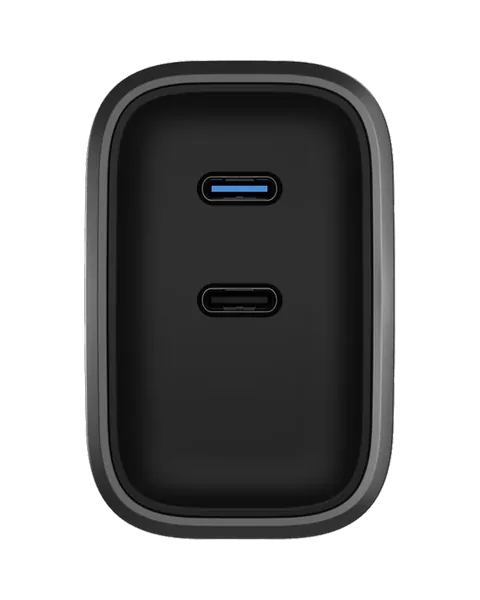
A charger worth its price tells you what is inside. The Fermi45 lists every rail it offers, from 5 V 3 A to 20 V 2.25 A, names its over-voltage, over-current, over-temperature and short-circuit protection, and draws under 0.05 W when idle.
Its GaN3 power stage gives 45 W with PPS and Samsung Super Fast Charging 2.0, full speed for an iPhone 17 or a 45 W Galaxy S, in a body 62.5 × 42 × 36 mm.
Step by step
- Find the BIS registration number printed on the charger.
- Verify it on the BIS CRS portal or BIS CARE app.
- Read the output ratings for each voltage and current.
- Buy from a traceable seller and keep the bill for warranty.
- Retire any charger that is cracked, buzzing loudly or too hot to hold.
Questions people ask
Are cheap chargers dangerous?
Not all, but counterfeit and unregistered chargers often cut safety parts. Ken Shirriff's teardown of a fake laptop charger found under 1 mm between mains and low-voltage sides, where at least 4 mm is recommended, and no protection controller. Buy registered chargers from traceable sellers and check the BIS number.
How can I tell a fake charger from a genuine one?
Check the BIS registration number on the BIS CRS portal or BIS CARE app, look for precise output ratings and clean printing, and buy from an authorised seller. Uneven seams, a crooked label or a hollow feel are warning signs. Only a teardown proves what is inside, so registration and seller matter most.
What is a hipot test on a charger?
A dielectric withstand or hipot test applies a high voltage across the charger's insulation and measures leakage current. If leakage stays below the limit set by the product standard, the insulation passes. It checks the barrier between mains voltage and the part you touch.
Does a more expensive charger charge faster?
Not necessarily. Charging speed is set by the phone and the protocol it uses. A well-made charger costs more because of safety parts, filtering and testing, and often a smaller size from GaN. Two chargers with the same profile will charge a phone at the same speed.
Sources
- Ken Shirriff's blog: Counterfeit MacBook charger teardown · Mar 2016
- IEA 4E PECTA: Energy efficiency measurement of wide bandgap-based power adapters · Mar 2024
- MacRumors: Teardown of 140W MacBook Pro power adapter shows what's inside · 29 Oct 2021
- Wikipedia: Hipot (dielectric withstand test) · accessed 22 Nov 2026
- USB Implementers Forum: Compliance program · accessed 22 Nov 2026
- Bureau of Indian Standards: Compulsory Registration Scheme portal · accessed 22 Nov 2026
- Wikipedia: Bureau of Indian Standards · accessed 22 Nov 2026
GaN — Gallium Nitride
The semiconductor that let chargers shrink.
Read →Explainer · 5 min readHow chargers are tested before they ship
From prototype to the last unit off the line, each stage asks a different question.
Read →Explainer · 4 min readHotel room charging: making one socket work
One socket behind the bed, three devices, a 7 am meeting. Here is the plan.
Read →Explainer · 5 min readGaN chargers: what changed and what did not
A new material shrank the charger. Your phone's charging speed stayed where it was.
Read →Explainer · 4 min readWhat happens inside a charger when you plug it in
Between the wall and your phone, a charger does six jobs in a box you can close a fist on.
Read →Explainer · 5 min readHow to charge two laptops from one charger
In one lab test, a 65 W charger gave the second laptop 0 W. Here is how to avoid it.
Read →