Journal · Explainer · 5 min read
How to choose the right charger in 30 seconds
Four questions, asked in order, cut a wall of chargers down to two or three.
The shop has forty chargers on the wall. They come in white and black, 20 W to 140 W, one port to four. You have half a minute before the salesperson recommends the most expensive one. What should you actually look at?
Short answerAsk four things in order. Which connector do my devices use? How many watts does my largest device need? Which protocol does my phone use for its top speed: USB PD, PPS, or its own? Does the charger carry a BIS registration? A charger that answers all four for your devices is the right one. Everything else is styling.
The reference numbers to carry in your head
Phones: Apple's fast-charge page says iPhone Air and iPhone 17e reach about 50% in 30 minutes with 20 W or higher, iPhone 17 models in about 20 minutes with 40 W or higher, and iPhone 18 Pro models in about 15 minutes with a 60 W-capable adapter. Google's Pixel help names a 30 W or higher PPS charger as the best option, with other USB PD adapters of 15 W or more as the alternative, and notes that real speeds vary by Pixel model. Samsung's UK support page says Galaxy S24 super fast charging needs a 45 W adapter and a 5 A cable.
Laptops: Apple's 13-inch MacBook Air with M5 ships with a 40 W adapter and fast charges from a 70 W or higher USB PD source.
Ceilings: the USB-IF says USB PD was limited to 100 W at 20 V over 5 A cables, and PD 3.1 raised that to 240 W. A charger above 100 W matters only for large laptops.
| Device | Charger for top speed |
|---|---|
| iPhone Air, iPhone 17e | 20 W or higher |
| iPhone 17 models | 40 W or higher |
| iPhone 18 Pro models | 60 W-capable |
| Pixel | 30 W or higher PPS |
| Galaxy S24, super fast | 45 W adapter, 5 A cable |
| MacBook Air 13 in, M5 | 70 W or higher USB PD |
Source: Apple; Google Pixel Help; Samsung UK Support
Adapter (W)
Source: Apple; Google Pixel Help; Samsung UK Support
How the four questions work together
The connector decides what you can plug in. The watts decide how fast your biggest device can go. The protocol decides whether your phone unlocks that speed. The safety mark decides whether you should trust it with your devices at all.
Each question narrows the wall. Most modern phones, tablets and laptops use USB-C, so a USB-C charger removes the old USB-A models at a stroke. The wattage question removes the small ones. The protocol question removes the ones that will not speak your phone's language. The BIS check removes the rest.
Think of buying shoes. Size first, then purpose, running or office, then fit, then the stitching. Colour comes last. Chargers are the same: compatibility first, styling last.
The 30-second routine
Seconds 0 to 5: turn the charger over. Look for USB-C ports and the printed output table.
Seconds 5 to 15: find the highest wattage the table offers on one port, and compare it with your phone or laptop's figure. Equal or higher is fine; a phone never takes more than it asks for.
Seconds 15 to 25: look for PD and, for Samsung and Pixel phones, PPS. For phones with their own fast-charge brand, such as SUPERVOOC, look for that name.
Seconds 25 to 30: find the BIS registration number, an R followed by digits, printed near the safety marks. No number, no purchase.
How to read an output table
Every charger prints a small table of outputs, often in grey on grey. Each line pairs a voltage with a current, such as 5 V at 3 A, 9 V at 3 A, 15 V at 3 A or 20 V at 3.25 A. Multiply the two and you get watts: 20 V at 3.25 A is 65 W.
If you see a line with a range of voltages, such as one beginning around 3 V and rising to 11 V or more, that is the PPS line. Phones that need PPS read this line, not the fixed ones.
On multi-port chargers, look for a second table or a list of combinations, such as C1 plus C2. That is where you learn what each port really gets when both are busy.
Three common mistakes
Buying by the number on the front. A large wattage printed on the face may be the total across all ports, not what one port can deliver.
Forgetting the cable. An old 3 A cable can quietly cap a 100 W charger at 60 W, and the charger gets the blame.
Ignoring the protocol. A phone that fast charges only over PPS or its own system will charge slowly on a large charger that lacks it.
What to check before you buy
If you have more than one device, read the per-port table. A 65 W two-port charger may give 45 W and 20 W, not 65 W to each.
Check the cable. A charger's top current above 3 A needs a cable rated for 5 A. Cables that pass the USB-IF's compliance programme can carry its power logos, which Tom's Hardware reported in 2021 as 60 W and 240 W.
Check the input range. Apple's adapters, for comparison, are built for 100 V to 240 V at 50 Hz to 60 Hz, which also suits Indian mains and foreign travel.
Keep the GST invoice. It is your warranty proof.
Myth corner
Myth: buy the biggest charger you can, just in case. A bigger charger costs more and fills more of your bag, and a phone will not charge faster than its own limit. Buy for your largest real device, with a little headroom.
The right one for you
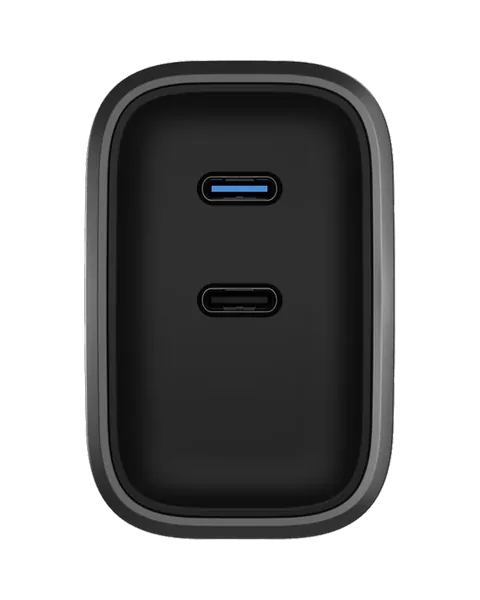
Run the four questions on the Fermi45 and the answers are on its label: USB-C, 45 W from one port, fixed steps from 5 V to 20 V, and a PPS line from 5 to 20 V at 3 A, with Samsung Super Fast Charging 2.0. That covers an iPhone 17's 40 W mark, a Pixel's 30 W PPS and a 45 W Galaxy. With both USB-C ports busy, it splits 25 + 20 W or 30 + 15 W.
Step by step
- Confirm your devices use USB-C and the charger has USB-C ports.
- Match the charger's single-port wattage to your largest device's figure.
- Check for PD, PPS or your phone's own fast-charge name.
- Find the BIS registration number on the label.
- For multiple devices, read the per-port split.
Questions people ask
How many watts charger do I need for my phone?
Match your phone's published fast-charge figure. Apple cites 20 W for iPhone Air and 17e, 40 W for iPhone 17 models and 60 W-capable adapters for iPhone 18 Pro. Google recommends 30 W PPS for Pixels; Samsung cites 45 W for Galaxy S24 super fast charging.
Is it safe to use a higher-watt charger than my phone supports?
Yes, with a standards-compliant USB PD charger. The phone requests only what it can handle. A 65 W charger on a 20 W phone delivers about 20 W. The extra headroom is useful only for larger devices like laptops.
What is the difference between PD and PPS?
USB PD offers fixed voltage steps such as 5 V, 9 V, 15 V and 20 V. PPS, part of USB PD, lets the phone request finely adjusted voltages during charging. Samsung and Pixel phones use PPS for their fastest speeds; iPhones use standard PD.
How do I check if a charger is genuine in India?
Look for the BIS registration number, an R followed by digits, printed on the charger. You can check it on the BIS CRS portal. Also check that the brand, model and ratings on the label match the box and invoice.
Do I need a GaN charger?
Not for function. GaN chargers are usually smaller and run cooler for the same wattage, which helps in a travel bag or multi-port charger. A well-made silicon charger of the same rating charges your phone just as fast.
Sources
- Apple Support: Fast charge your iPhone · accessed 22 Nov 2026
- Google Pixel Help: Fix a Pixel phone that won't charge or turn on (charger ratings) · accessed 22 Nov 2026
- Samsung UK Support: How to use super fast charging on Galaxy S24 series · accessed 22 Nov 2026
- Apple: MacBook Air technical specifications · accessed 22 Nov 2026
- USB-IF: USB Charger (USB Power Delivery) · accessed 22 Nov 2026
- Apple Support: About Apple USB power adapters · accessed 22 Nov 2026
- Tom's Hardware: New USB logos show charging capabilities up to 240W · 1 Oct 2021
- BIS CRS portal: Search by registration number · accessed 22 Nov 2026
USB-C Power Delivery
One connector, a negotiated contract.
Read →Comparison · 4 min readOriginal vs third-party chargers: what really differs
The real line is not between brands. It is a 4 mm gap inside the plastic.
Read →Explainer · 5 min readHow to charge everything on one 65 W charger
Sixty-five watts is a budget. Spend it in the right order and it covers the whole bag.
Read →Explainer · 5 min readUSB Power Delivery explained in one page
How a charger and a phone agree on power before it flows, and how to read the label.
Read →Explainer · 5 min readPPS: why Samsung phones care about it
Three letters on a charger label decide whether a Galaxy charges at full speed or half.
Read →Explainer · 4 min readCan you use a Samsung charger on an iPhone?
Different logos, same plug, shared standard. What decides the speed is two letters: PD.
Read →