Journal · Comparison · 4 min read
Original vs third-party chargers: what really differs
The real line is not between brands. It is a 4 mm gap inside the plastic.
The phone came without a charger, and the shop shelf offers three choices: the phone maker's own brick, a third-party brand at a lower price, and a cheap unbranded one at the counter. They all say the same wattage. What actually differs between them?
Short answerA good third-party charger can match the original on speed and safety, provided it supports your phone's charging standard and is properly tested. The real danger is the counterfeit or lookalike. In Electrical Safety First's 2024 study, every one of 116 fake or lookalike chargers failed safety tests, and 92 per cent failed the mains insulation test.
Side by side: the numbers that separate them
Speed first. ChargerLAB tested a wide set of chargers and power banks on the Galaxy S24 Ultra, which is rated for 45 W. The phone maker's own 65 W charger delivered about 44.5 W. Several third-party chargers reached the same level, with one tested at about 44.4 W. Others delivered as little as 11 W, and one large-brand 140 W charger gave only about 22 W, because it did not trigger the phone's 45 W mode. Brand on the plug did not decide speed; protocol support did.
Efficiency and heat next. Tom's Hardware tested 20 wall chargers in 2026 and found most converted 89 to 93 per cent of wall power into output. The least efficient unit was a phone maker's own 15 W charger, at about 85 per cent. Surface temperatures ranged from about 52 °C on the coolest small charger to 76.4 °C on a 140 W model, and one 100 W model ran slightly hotter still. Bigger output means more heat to shed, whoever makes the charger.
Safety last, and here the gap is huge. Electrical Safety First's report tested 116 counterfeit and lookalike 20 W USB-C chargers bought in the UK and EU. All failed. 107 failed the electric strength test, which checks insulation between mains and the USB output; 13 failed at under half the test voltage. Of nine that passed that test, four still had inadequate creepage and clearance distances.
| Finding | Result |
|---|---|
| Chargers tested | 116 |
| Failed safety tests | All 116 |
| Failed the electric strength test | 107 |
| Failed at under half the test voltage | 13 |
| Weights found inside, of 22 opened | 68 per cent |
Source: Electrical Safety First, Leading the Charge on Counterfeits, 2024
Watts measured
Source: ChargerLAB, 45W compatibility test of Samsung Galaxy S24 Ultra
The one number that decides it: the 4 mm gap
Inside every mains charger is a wall between two worlds: 230 V from the socket on one side, about 5 to 20 V at the USB port on the other. Engineers keep the two apart with a safety gap. In Ken Shirriff's teardown of a counterfeit laptop charger, the required gap was at least 4 mm. The fake had under 1 mm.
Think of a road divider on a highway. Most days, nobody crosses it, so a thin painted line looks as good as a concrete barrier. The difference appears only on the bad day, during a mains surge in a storm or a fault in the transformer. A 1 mm gap is the painted line. On that day it is the only thing between mains voltage and the cable in your hand.
The same teardown found the fake's ground pin was not connected, its controller chip's datasheet suggested use under 30 W in a charger sold as 45 W (a reader who had used the chip disputed that limit), and the output had spikes of 2.7 V peak to peak.
Where original chargers still have an edge
An original charger is designed against one phone's exact charging profile, so it reaches the advertised speed without guesswork. Some phones use their own fast-charging systems that only the matching charger and cable unlock.
Service is simpler. If the original charger and phone come from the same brand, one service centre handles both.
Where good third-party chargers often win
Flexibility. A phone maker's charger is built for its own phone. A good third-party charger often adds more ports and wider protocol support, so one brick can serve a phone, earbuds and a laptop.
Standby draw is a wash. Tom's Hardware measured idle consumption of about 0.3 W for chargers without displays, and about 1 W for those with a screen, whoever made them.
What to check before you buy
Check for the BIS registration mark and number on the charger. BIS lists power adaptors for IT equipment under IS 13252 (Part 1) in its compulsory registration scheme, and you can search the number on the BIS portal.
Match the protocol to your phone: USB PD for iPhones and Pixels, PD with PPS for Galaxy phones, the maker's own system where it matters.
Feel the weight and look at the print. ESF found metal weights inside 68 per cent of the 22 fakes it opened for closer study, added to mimic a real charger's heft. Fuzzy text, missing output lines and spelling errors are warning signs.
Buy from the brand's own store or an authorised seller, and keep the GST invoice for warranty.
Myth corner
Myth: only the phone maker's charger is safe. Safety comes from design, components and testing, not from the logo. Tom's Hardware's test found third-party chargers among the most efficient and the coolest, while the fakes ESF tested failed almost every check.
The right one for you
A charger that is neither the original nor a gamble has to speak your phone's charging language and protect itself on the bad day.
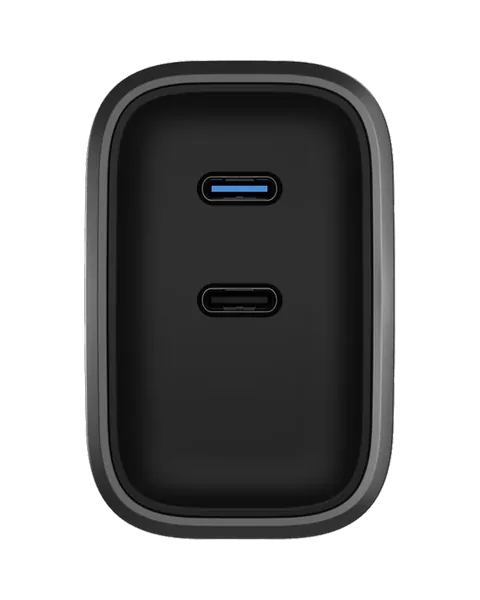
The Fermi45 gives 45 W from one USB-C port with USB PD, PPS and Samsung Super Fast Charging 2.0, so a 45 W Galaxy such as the S24 Ultra and an iPhone 17 both charge at full speed.
Behind its GaN3 power stage sit over-voltage, over-current, over-temperature and short-circuit protection, and it draws under 0.05 W when left idle on the wall.
Step by step
- Find your phone's charging standard and rated watts on the maker's spec page.
- Choose a charger that lists that standard, such as USB PD or PPS.
- Check the BIS registration number on the charger and verify it on the BIS portal.
- Buy from an authorised seller and keep the GST invoice.
- Reject chargers with fuzzy print, missing output specs or unusually low prices for big brands.
Questions people ask
Will a third-party charger damage my phone battery?
Not if it is well made and supports a standard your phone uses. The phone controls how much current it accepts, so a compliant charger cannot force extra power in. The risk comes from fakes with poor insulation and no protection, which can fail dangerously.
Why does a third-party charger charge my phone slower?
Usually it lacks the exact fast-charging profile the phone wants. In ChargerLAB's Galaxy S24 Ultra test, one 140 W charger delivered only about 22 W because it did not trigger the phone's fast mode, while other third-party chargers reached about 44 W. Check that the charger lists PPS or your phone's own system.
How can I tell a fake charger from a real one?
Check for a BIS registration number and verify it on the BIS portal. Look for clear printing, a full output specification and a proper seller invoice. An unusually low price for a big brand name is the most common warning sign. Weight alone is not reliable; ESF found metal weights added inside many fakes.
Does using a third-party charger void my phone warranty?
Using a working, compliant charger does not usually affect the warranty. Damage caused by a faulty charger may not be covered, which is another reason to avoid unbranded units and keep the invoice for any charger you buy. Check your phone maker's warranty terms for exact wording.
Are original chargers more efficient?
Not necessarily. In Tom's Hardware's test of 20 chargers, most achieved 89 to 93 per cent efficiency, and the least efficient was a phone maker's own 15 W unit, at about 85 per cent. Efficiency followed the design inside, not the logo outside.
Sources
- Electrical Safety First: Leading the Charge on Counterfeits (v1.9) · Nov 2024
- Ken Shirriff: Counterfeit MacBook charger teardown · Mar 2016
- ChargerLAB: 45W compatibility test of Samsung Galaxy S24 Ultra · accessed 22 Nov 2026
- Tom's Hardware: We tested 20 wall chargers from 15 to 140W · Jun 2026
- BIS: Scheme II registration scheme, products under compulsory registration · accessed 22 Nov 2026
USB-C Power Delivery
One connector, a negotiated contract.
Read →Buying guide · 1 min readChoosing a USB-C charger: a short, honest checklist
Five checks that outlast any marketing cycle.
Read →Comparison · 4 min readSingle-port vs multi-port chargers
The big number on the box is shared. The table on the back says what each device gets.
Read →Comparison · 6 min read25 W vs 45 W for a Galaxy: what you actually gain
The extra 20 W looks big on the box. On the clock, it is a few minutes.
Read →Buying guide · 4 min readOne charger for phone, tablet and laptop: how many watts?
Add up what each device takes, then decide how patient you are. That is the calculation.
Read →Buying guide · 4 min readWhich charger for two phones at once?
Two phones, one socket, both fast. The answer is in the shared-port line of the label.
Read →