Journal · Explainer · 5 min read
Why proprietary fast charging does not work on other chargers
An 80 W phone on a 100 W charger can charge slower. The cause is a language, not a number.
You plug a phone rated for 80 W into a 100 W laptop charger. The phone charges, but slower than with its own little brick. A bigger charger, a slower result. What is going on?
Short answerProprietary fast charging is a private protocol. The phone unlocks its top speed only when the charger answers in that protocol, through a cable built for its current. Any other charger, however powerful, gets the common slower mode, usually USB Power Delivery. Nothing is broken; the two sides simply share a smaller vocabulary.
Open versus private: the numbers that differ
The open standard is USB Power Delivery from the USB Implementers Forum. Under it, a charger lists its fixed voltage options, and before PD 3.1 the ceiling was 100 W at 20 V over cables rated at 5 A. PD 3.1 added 28 V, 36 V and 48 V for 140 W, 180 W and 240 W. Granite River Labs, a test lab, notes that PD's programmable mode adjusts voltage in 20 mV steps, and the newer adjustable mode for higher voltages steps in 100 mV.
Proprietary systems choose a different path. Oppo's VOOC family, used by OnePlus and others, favours high current at low voltage. Public technical summaries of the VOOC family list the 2020 SUPERVOOC generation at 10 V and 6.5 A, about 65 W, and the 2022 version at 11 V and 7.3 A, about 80 W. The 240 W version runs at 20 V and 12 A and needs its own proprietary charger and cable to reach that rate.
Compare those currents with the cable world. A standard USB-C cable tops out at 5 A. A 7.3 A or 12 A system cannot run over it, so it needs special cables, and the charger needs to know such a cable is present.
| System | Voltage | Current | Power |
|---|---|---|---|
| USB PD before 3.1 | 20 V | 5 A | 100 W |
| USB PD 3.1 | Up to 48 V | 5 A | 240 W |
| SUPERVOOC, 2020 | 10 V | 6.5 A | About 65 W |
| SUPERVOOC, 2022 | 11 V | 7.3 A | About 80 W |
| VOOC 240 W | 20 V | 12 A | 240 W |
Source: USB-IF; VOOC (Wikipedia), accessed 22 Nov 2026
Amps
Source: USB-IF; VOOC (Wikipedia), accessed 22 Nov 2026
How the handshake decides the speed
Every fast charge starts with a conversation. Granite River Labs describes the PD sequence for the higher-power range: the charger sends a list of what it can supply, the phone requests one option, the charger accepts, adjusts its output and confirms it is ready. Only then does high power flow.
A proprietary charger adds its own private messages to that conversation, or replaces it. If the phone hears the right reply, it unlocks the high-current mode. If it hears only standard PD, it picks the best standard option on offer. If it hears neither, it stays at a basic 5 V level.
It is like a members-only lane at a toll plaza. Any car can pay at the normal booth and get through. Only cars with the right tag on the windscreen use the fast lane. A bigger car does not get the tag lane; the tag does.
Samsung shows the middle path
Not every brand locks the fast lane. Samsung's UK support page for the Galaxy S24 series says super fast charging needs a 45 W adapter and a 5 A, e-marked USB-C cable, that a standard cable supports only 25 W, and that super fast charging will not work with a standard charger. Because Samsung's system sits on the open USB PD family rather than a fully private protocol, chargers from other makers with the right programmable output can reach it, while a basic charger falls back to lower speeds.
Apple takes the open route outright. Its fast-charge support page says an iPhone 15 or later fast charges with an Apple 18 W or higher USB-C adapter or a comparable third-party adapter that supports USB-PD, and the newest models list higher wattages on the same open standard. That is why one good PD charger works across iPhone, iPad and MacBook. The trade-off is that peak speeds are lower than the most aggressive private systems.
What to check before you buy
Find your phone's fast-charge name on the box or support page: SUPERVOOC, FlashCharge, HyperCharge, Super Fast Charging or plain USB PD. That name tells you which charger unlocks the top speed.
If you want the top speed of a private system, buy the charger and the cable as a pair from that system. A matching charger with an ordinary cable usually drops to a slower mode, because the cable cannot carry the extra current.
If you want one charger for many devices, choose USB PD with a programmable output, often printed as PPS on the label, and accept that some phones will charge slower than their peak.
Read the label, not the headline wattage. A charger's output table shows which voltages and currents it offers. A large number on the front means little if the phone cannot request it.
Ignore cables that only say fast. Check the current rating: 3 A, 5 A, or the brand's own rating for proprietary systems.
Myth corner
Myth: using another brand's charger damages a phone with proprietary charging. In normal use it does not. If the protocols do not match, the phone simply declines the high-power mode and charges at a level both sides agree on. The real risk is a poorly built charger with no BIS registration, not a mismatched brand.
The right one for you
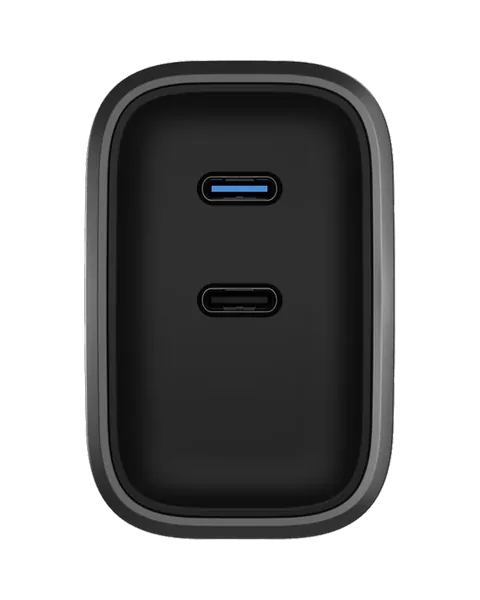
If you would rather keep one open-standard charger, the label is where the answer lives, and the Fermi45 prints its table in full: 5 V to 15 V at 3 A, 20 V at 2.25 A, and PPS from 5 to 20 V.
It also speaks Samsung Super Fast Charging 2.0, so a 45 W Galaxy reaches 45 W from one port with a 5 A cable, and it charges the iPhone 17 series over USB PD. A phone with a private protocol charges on it at a standard PD rate, safely.
Step by step
- Find your phone's fast-charging system name on the box or support page.
- For peak speed, use the charger and cable that support that system.
- For one shared charger, choose USB PD with PPS and read its output table.
- Check the cable's current rating, 3 A or 5 A, before blaming the charger.
Questions people ask
Will a laptop USB-C charger fast charge my phone?
It will charge it safely, and often quickly, through USB Power Delivery. But if your phone uses a proprietary system such as SUPERVOOC, it reaches its top speed only on its own charger and cable. On a laptop charger, it uses the slower common standard.
Is USB PD the same as PPS?
PPS, or Programmable Power Supply, is part of the USB PD family. Standard PD offers fixed steps such as 5 V, 9 V, 15 V and 20 V. PPS lets the phone fine-tune voltage in 20 mV steps, which some phones, including many Samsung models, need for their fastest modes.
Why does a proprietary charger need its own cable?
Some proprietary systems push more current than USB-C cables are built for. A standard cable tops out at 5 A, while SUPERVOOC generations run at 6.5 A, 7.3 A and up to 12 A. The special cable carries that current and identifies itself to the charger.
Can a proprietary charger fast charge an iPhone?
Only if it also supports USB Power Delivery. iPhones fast charge over USB PD. Many proprietary chargers include a PD mode at a lower wattage; check the output table on the label for PD voltages and currents.
Is it bad to use a slower charger regularly?
No. A slower, standard charge is fine for the battery and often runs cooler. You only lose time. Use the fast proprietary charger when speed matters and any good standard charger the rest of the time.
Sources
- USB-IF: USB Charger (USB Power Delivery) · accessed 22 Nov 2026
- Granite River Labs: USB Power Delivery Specification 3.1 · accessed 22 Nov 2026
- VOOC (Wikipedia summary of generations, voltages and currents) · accessed 22 Nov 2026
- Samsung UK Support: How to use super fast charging on Galaxy S24 series · accessed 22 Nov 2026
- Apple Support: Fast charge your iPhone · accessed 22 Nov 2026
USB-C Power Delivery
One connector, a negotiated contract.
Read →Explainer · 5 min readPPS: why Samsung phones care about it
Three letters on a charger label decide whether a Galaxy charges at full speed or half.
Read →Explainer · 4 min readDo original chargers matter?
The logo on the plug matters less than two words in its small print.
Read →Explainer · 6 min readWhat 'fast charging' means on each brand
The same two words on every box. Behind them, five different rulebooks.
Read →Explainer · 5 min readQuick Charge, PD, SuperVOOC, HyperCharge: who uses what
Four names, two ideas, one cable shape. A map of who speaks which charging language.
Read →Buying guide · 5 min readWhich charger does the Galaxy S26 need?
Three phones, three speeds, one protocol called PPS. Here is what to buy and what to skip.
Read →