Journal · Explainer · 5 min read
How to read a charger's rating plate
Thirty seconds with the small print tells you more than the box ever will.
Turn any charger over and you will find a block of tiny grey text: voltages, amps, a row of symbols, a code that looks like a serial number. Most people never read it. Yet those few lines answer every question you ask at the counter. Will it charge my laptop? Will it work abroad? Is it built properly?
Short answerThe input line says what the charger accepts from the wall, such as 100-240 V at 50/60 Hz. The output lines list each voltage it can supply and the maximum current at each, such as 20 V at 3.25 A. Multiply volts by amps for watts. The symbols show insulation class, efficiency level and regulatory marks.
The numbers on real labels
Input: the line starting Input. A charger ChargerLAB tore down listed 100-240 V with a maximum input current of 1.8 A; ASUS lists its 65 W laptop adapter as 100-240 V AC at 50 or 60 Hz. A wide range like this means the charger works anywhere from Japan to India without a voltage converter, only a plug adapter.
Output: one line per voltage. ASUS rates its 65 W adapter at 20 V and 3.25 A, which multiplies to 65 W. The basic adapter Sony supplies with one camera in some regions is rated 5 V at 1.5 A, only 7.5 W, while Sony recommends a USB PD adapter offering 9 V at 2 A and 15 V at 2 A for faster charging. Comparing lines like these tells you more than a single headline wattage.
Total versus per-port: multi-port chargers often list a total output and separate figures for each port. In ChargerLAB's 100 W three-port example, the main USB-C port supplied up to 100 W, the second USB-C port up to 30 W and the USB-A port up to 22.5 W. The total is shared; it is not available on every port at once.
Protocols: many labels add PD, PPS or other fast-charging names, sometimes with a PPS range such as 5-21 V. These tell you which phones and laptops will fast-charge.
| Charger on the label | Output line | What it tells you |
|---|---|---|
| ASUS 65 W laptop adapter | 20 V, 3.25 A | 20 × 3.25 = 65 W on one line |
| Sony basic camera adapter | 5 V, 1.5 A | Only 7.5 W |
| Sony recommended USB PD adapter | 9 V 2 A and 15 V 2 A | Faster charging for the camera |
| ChargerLAB 100 W three-port example | 100 W / 30 W / 22.5 W | Per-port maximums; the total is shared |
Source: ASUS, Sony and ChargerLAB, accessed 22 Nov 2026
Maximum output (W)
Source: ChargerLAB teardown, accessed 22 Nov 2026
The symbols, one by one
Square inside a square: double insulation, or Class II. Reference sources explain that a Class II appliance uses reinforced or two layers of insulation between live parts and the user, so it needs no earth. Most phone and laptop chargers are Class II, which also isolates the low-voltage output from the mains.
AC and DC marks: a wavy line means alternating current, on the input. A solid line over a dashed line means direct current, on the output.
Roman numeral in a circle: an efficiency level mark used under energy rules for external power supplies. The US Department of Energy notes that makers have had to meet its efficiency standards for these supplies since 2007.
Indoor use only: a house symbol means the charger is not designed for damp or outdoor locations.
BIS Standard Mark: in India, BIS's Compulsory Registration Scheme requires its mark on certain electronics and IT goods, with a registration number beside it.
Crossed-out wheelie bin: do not throw it in household waste; take it to an e-waste collection point.
How to use the label at the counter
Find your device's need first: the laptop's original adapter label, or the phone maker's support page. Then read the new charger's output lines and look for a voltage and current pair that covers it. A laptop that came with a 20 V, 3.25 A adapter needs a line of at least 20 V and 3.25 A on one port.
Think of it like reading a nutrition label. The front of the pack says healthy; the table on the back tells you exactly what is in it. The box says 100 W; the rating plate tells you whether that 100 W is on the port you will use.
Labels on cables and power banks
Cables carry ratings too, often printed on the box or moulded into the plug: 60 W, 100 W or 240 W, sometimes with a data speed. A 60 W cable on a 100 W charger limits the output, however good the charger's label looks.
Power banks add a capacity line in mAh and, more usefully, in watt-hours. The watt-hour figure is what airlines check for cabin limits, so a power bank without a clear Wh figure can cause trouble at the security check.
What to check before you buy
Read the input range. For travel, 100-240 V and 50/60 Hz is what you want.
Read the output table, not just the headline watts, and find the line that matches your device.
On multi-port chargers, find the per-port figures and the rules when several ports are used. A plate that prints the exact split for each combination of ports is one that has nothing to hide.
Look for the double-square symbol, the BIS mark with a registration number, and a maker name and address.
Be wary of labels with blurry print, missing details or only a single wattage figure.
Myth corner
Myth: a higher amp rating on the charger will force too much current into the phone. The amp figure is a maximum the charger can supply, not what it pushes. The device draws only what it needs, and under USB Power Delivery both sides agree a level before power flows.
The right one for you
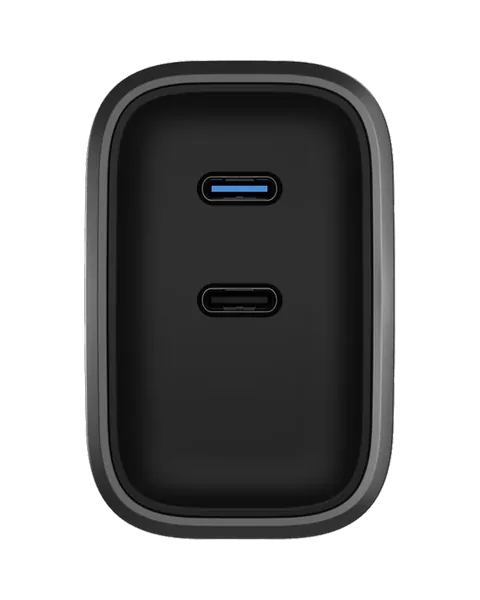
A rating plate is only as useful as what it is willing to tell you, and the Fermi45 tells you everything this guide asks for. Its input reads 100–240 V at 50–60 Hz, its output lists each voltage step with its current, from 5 V 3 A to 20 V 2.25 A, and it states how its 45 W divides when both USB-C ports are in use: 25 + 20 W or 30 + 15 W.
It is made for the iPhone 17 series and the Galaxy phones that take 45 W, through PPS and Samsung Super Fast Charging 2.0. Turn it over at the counter and read it line by line; nothing on it needs guessing.
Step by step
- Read the input line and confirm 100-240 V, 50/60 Hz.
- Find your device's required voltage and current.
- Find an output line on the charger that meets or exceeds both.
- Check per-port figures on multi-port chargers.
- Look for the double-square symbol, the BIS mark and maker details.
Questions people ask
What does 100-240 V on a charger mean?
It is the input range the charger accepts from the wall. A charger rated 100-240 V at 50/60 Hz works on mains supplies worldwide, including India's 230 V, 50 Hz. Abroad you need only a plug adapter for the socket shape, not a voltage converter.
How do I calculate watts from a charger label?
Multiply the output voltage by the current on the same line. For example, 20 V at 3.25 A is 65 W, and 5 V at 1.5 A is 7.5 W. A charger usually lists several lines; the highest product is its maximum on that port.
What does the square inside a square symbol mean?
It marks a Class II or double-insulated appliance. It has reinforced or two layers of insulation between live parts and the user, so it needs no earth connection. Most phone and laptop chargers are Class II, which also isolates the low-voltage output from mains.
Why does my 100 W charger not give 100 W to every port?
The 100 W is usually the total output, shared between ports. Labels often list per-port maximums and lower figures when several ports are in use. In one 100 W three-port charger ChargerLAB tested, only one USB-C port reached 100 W, while the others were rated 30 W and 22.5 W.
What is the efficiency mark on a charger?
It is a Roman numeral, often in a circle, showing which efficiency level an external power supply meets under energy rules. The US Department of Energy notes that external power supplies have had to meet its efficiency standards since 2007. Higher levels mean less wasted power.
Sources
- Teardown of a 100 W GaN charger with retractable USB-C cable, ChargerLAB · accessed 22 Nov 2026
- ROG Ally (2023) specifications, ASUS · accessed 22 Nov 2026
- ILCE-7M4 Help Guide: Specifications, Sony · accessed 22 Nov 2026
- Appliance classes, Wikipedia · accessed 22 Nov 2026
- External power supplies, US Department of Energy · accessed 22 Nov 2026
- Bureau of Indian Standards, Wikipedia (Compulsory Registration Scheme) · accessed 22 Nov 2026
USB-C Power Delivery
One connector, a negotiated contract.
Read →Explainer · 5 min readHow to choose the right charger in 30 seconds
Four questions, asked in order, cut a wall of chargers down to two or three.
Read →Explainer · 5 min readUSB Power Delivery explained in one page
How a charger and a phone agree on power before it flows, and how to read the label.
Read →Explainer · 5 min readPPS: why Samsung phones care about it
Three letters on a charger label decide whether a Galaxy charges at full speed or half.
Read →Explainer · 4 min readCan you use a Samsung charger on an iPhone?
Different logos, same plug, shared standard. What decides the speed is two letters: PD.
Read →Explainer · 4 min readDo original chargers matter?
The logo on the plug matters less than two words in its small print.
Read →