Journal · Explainer · 4 min read
Do you need a new charger for every new phone?
The box has no charger, the counter has forty. Your drawer may already have the right one.
The new phone arrives in a slim box with a cable and no charger. Your drawer holds three bricks from earlier phones. The shop suggests a new one, made for this model. Do you really need it?
Short answerUsually not. Most phones now charge over USB-C using the open USB Power Delivery standard, so a good USB-C PD charger keeps working across generations and brands. You need a new one only if the old one is USB-A only, falls below the new phone's fast-charge wattage, lacks PPS the phone needs, or the top speed uses a proprietary protocol.
What the makers and labs say
Apple's page on its USB power adapters says any of its listed adapters can charge an iPhone, iPad, Apple Watch or iPod, and that Mac USB-C adapters also work. Its fast-charge page, under earlier iPhone models, says an iPhone 15 or later fast charges over a USB-C cable with an Apple 18 W or greater adapter or a comparable USB PD adapter; the newest models list higher figures.
ChargerLAB's comparison of Apple chargers on an iPhone 16 Pro shows how little the newest brick matters for many phones. The 20 W charger filled the phone in 2 hours 6 minutes and the 140 W in 1 hour 59 minutes. Only the very small chargers were far slower: 2 hours 53 minutes on 10 W and 7 hours 16 minutes on 5 W.
Regulation is pushing in the same direction. The European Union's Radio Equipment Directive, according to public summaries, requires new smartphones sold there to use USB-C by the end of 2024 and laptops by 2026, and requires makers to offer devices without a charger. Phones sold worldwide increasingly follow that design.
| Phone | Fast-charge need | Source |
|---|---|---|
| iPhone 15 and later | 18 W or more, USB PD | Apple |
| iPhone 17 | 40 W or more for about 50% in 20 min | Apple |
| Galaxy S26 Ultra | 60 W adapter | Samsung |
| Pixel | 30 W or more, PPS |
Source: Apple Support; Samsung Newsroom; Google Pixel Help
Minutes
Source: ChargerLAB, iPhone 16 Pro comparative charger test
Why a good USB-C charger carries over
USB Power Delivery is a negotiation, not a fixed output. The charger offers its menu of voltages and currents, and each phone picks what it can use. The USB-IF describes devices taking only the power they need. A charger built to that standard does not care which brand or generation is on the other end.
That is why a 30 W USB-C PD charger bought for one phone often charges the next one at full speed, and a laptop charger can charge any of them. The standard is the common language; the phone does the choosing.
Think of a good kitchen knife. You do not buy a new knife every time you change recipes. You buy a new one only when the job outgrows it: a cleaver for bones, a long knife for bread. Chargers are the same: replace them when the job changes, not when the phone does.
When a new charger does make sense
Your old charger is USB-A only, or below 18 W. Old 5 W and 10 W cubes are far slower on modern phones, as ChargerLAB's figures show.
Your new phone needs more watts. Apple says iPhone 17 models reach about 50% in about 20 minutes with 40 W or higher, and Samsung pairs the Galaxy S26 Ultra with a 60 W adapter. A 20 W brick will charge them, just more slowly.
Your new phone needs PPS. Samsung asks for PPS chargers for its fast modes, and Google recommends a 30 W or higher PPS charger for Pixels.
Your new phone uses a proprietary system you want at full speed, such as SUPERVOOC or FlashCharge. Only the matching charger and cable reach the headline figure.
What to check before you buy
Read your old charger's label first. Look for USB-C, the highest wattage on one port, and the words PD or PPS.
Compare it with your new phone's support page. If it meets the phone's figure and protocol, keep it.
Check the cable. A new phone often ships with a USB-C to USB-C cable that does not fit an old USB-A brick.
If you do buy, buy for the next phone too: a USB-C PD charger with PPS at 30 W to 65 W covers most phones and many tablets.
A quick audit of your charger drawer
Lay every charger out on a table and sort them into three piles. Pile one: USB-C, 18 W or more, with PD on the label. Keep these; they will charge almost any current phone well.
Pile two: USB-C but small, or USB-A with a decent rating. Keep one or two for earbuds, a watch or a bedside lamp, where speed does not matter.
Pile three: old 5 W cubes, unbranded bricks, anything with no safety marks, a cracked case or a loose plug. Take these to e-waste collection. One good charger in daily use beats five doubtful ones in a drawer.
Myth corner
Myth: using an older charger can damage a new phone. A compliant USB-C PD charger only supplies what the phone requests. The real risk is an old, unbranded or damaged charger, not an old one as such. Retire any brick with a cracked case, scorched pins or no safety markings.
The right one for you
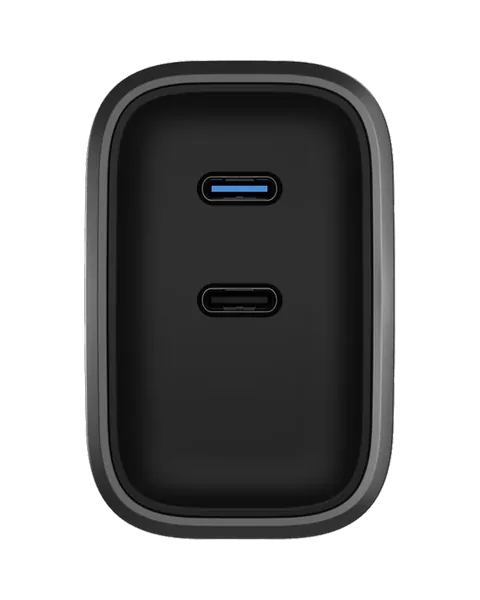
If you do buy, buy once for the next few phones. The Fermi45 gives 45 W over USB-C Power Delivery, above the 40 W Apple names for iPhone 17 fast charging, and it carries PPS and Samsung Super Fast Charging 2.0 for the Galaxy S phones that take 45 W.
Its two USB-C ports share the total when a second device joins, and its GaN3 body measures 62.5 × 42 × 36 mm.
Step by step
- Read your current charger's label: connector, wattage, PD or PPS.
- Look up your new phone's recommended charging figure.
- Keep the old charger if it matches; check the cable fits.
- If upgrading, choose USB-C PD with PPS at 30 W to 65 W.
Questions people ask
Can I use my old iPhone charger with a new iPhone?
Yes, if it is a USB-C adapter. Apple says any of its listed adapters can charge an iPhone, and lists an 18 W or greater USB-C adapter as enough to fast charge an iPhone 15 or later over a USB-C cable. Newer models such as iPhone 17 charge fastest at 40 W or more.
Why do new phones come without a charger?
Rules such as the EU's Radio Equipment Directive let customers buy devices without a charger, and USB-C with USB PD makes one charger usable across many devices. Check the box contents for your market before you buy, and look at what you already own first.
Will an old 5 W charger work with a new phone?
It will charge it, but very slowly. ChargerLAB found an iPhone 16 Pro took 7 hours 16 minutes on Apple's 5 W adapter, against about 2 hours on 20 W and above. Upgrade to at least an 18 W to 20 W USB-C PD charger.
Can I use a Samsung charger on an iPhone or the other way round?
Yes, if both use USB-C PD. Samsung's fast modes are built on PD with PPS, and iPhones charge over PD. The phone negotiates a safe level. Speeds depend on each phone's own limit.
How do I know if my old charger is good enough?
Read its label for USB-C, the single-port wattage and PD or PPS support. Compare with your phone's support page. If it meets the wattage and protocol, keep it. If it is USB-A only or under 18 W, consider upgrading.
Sources
- Apple Support: About Apple USB power adapters · accessed 22 Nov 2026
- Apple Support: Fast charge your iPhone · accessed 22 Nov 2026
- ChargerLAB: Comparative test of iPhone 16 Pro with Apple chargers at different power · accessed 22 Nov 2026
- Common external power supply (Wikipedia summary of EU rules; secondary source) · accessed 22 Nov 2026
- USB-IF: USB Charger (USB Power Delivery) · accessed 22 Nov 2026
- Samsung Newsroom: Samsung unveils Galaxy S26 series · accessed 22 Nov 2026
- Google Pixel Help: Fix a Pixel phone that won't charge or turn on (charger ratings) · accessed 22 Nov 2026
USB-C Power Delivery
One connector, a negotiated contract.
Read →Explainer · 5 min readUSB Power Delivery explained in one page
How a charger and a phone agree on power before it flows, and how to read the label.
Read →Explainer · 5 min readPPS: why Samsung phones care about it
Three letters on a charger label decide whether a Galaxy charges at full speed or half.
Read →Explainer · 4 min readCan you use a Samsung charger on an iPhone?
Different logos, same plug, shared standard. What decides the speed is two letters: PD.
Read →Explainer · 4 min readDo original chargers matter?
The logo on the plug matters less than two words in its small print.
Read →Explainer · 4 min readHow to check if your phone is fast charging
No meter needed. A clock, a low battery and the maker's own claim tell you most of it.
Read →