Journal · Explainer · 4 min read
Over-ear vs in-ear vs open-ear
Three ways to put sound near your ear, and each one trades something you will notice.
Ask a shop assistant for headphones and the first question back is often about price. The better first question is shape. A pair of in-ear buds, a pair of over-ear cans and a pair of open-ear hooks can cost the same and sound completely different, because each one meets your ear in a different way.
Short answerIn-ear models seal the ear canal, giving strong isolation and bass in a pocket-sized package. Over-ear headphones surround the ear for long-session comfort and larger batteries. Open-ear designs leave the canal open, keeping you aware of traffic and voices, but block almost no noise and give lighter bass. Choose by where you listen most.
How much noise each shape blocks
Wikipedia's summary of headphone research gives rough passive isolation figures: closed-back over-ear headphones block about 8 to 12 dB, and sealed in-ear models about 10 to 15 dB. Earbuds that sit in the outer ear without sealing provide hardly any isolation. Open-ear and bone-conduction designs, which leave the canal fully open, are built not to isolate at all.
Active noise cancelling adds to this. The same summary puts ANC at 20 dB or more of reduction, working best on constant, low-frequency sounds such as engines and fans. ANC is available in both in-ear and over-ear shapes.
Isolation matters for hearing as well as enjoyment. The WHO lists 80 dB as safe for 40 hours a week but 90 dB for only 4 hours. A shape that lets outside noise in tempts you to turn the volume up to compensate.
| Shape | Passive isolation | Example weight |
|---|---|---|
| Over-ear, closed-back | About 8 to 12 dB | About 386 g |
| In-ear, sealed | About 10 to 15 dB | 5.55 g per earbud |
| Earbuds, unsealed | Hardly any | 4.3 g each |
| Open-ear | None, by design | Not stated |
Source: Wikipedia, Headphones; Apple technical specifications, accessed 22 Nov 2026
How each shape makes bass
Bass is the part of the sound that suffers most when the seal breaks. An Audio Engineering Society paper on insert earphones reports that a leak only about 0.5 mm in diameter and 2.5 mm long can cut bass at 50 Hz by about 15 dB, a loss listeners clearly notice.
That is why in-ear models depend so heavily on tip fit, and why open-ear designs, which have no seal at all, sound lighter in the low end however large their drivers. Over-ear headphones sit in between: the cushion forms a seal around the ear, and closed-back cups usually produce stronger low frequencies than open-back ones.
Think of it like a dholak played in a closed room and in an open courtyard. The drum is the same. In the room, the low thump fills the space. In the courtyard, it escapes. A sealed earphone is the closed room; an open-ear design is the courtyard.
The three shapes at a glance
In-ear. Light, pocketable, strong isolation and bass when the tip fits. Apple's in-ear model with noise cancelling weighs 5.55 g per earbud. The catch: fit is personal, and a wrong tip size undoes most of the benefit. Some people find tips tiring after a few hours.
Over-ear. Comfortable for long sessions if the clamp is gentle, with room for large batteries; Apple's over-ear model lists up to 20 hours with noise cancelling. The catch: size, weight, around 386 g for that model, and heat around the ears in Indian summers.
Open-ear. Includes bone-conduction headbands and hook-style earbuds that sit outside the canal. Wikipedia describes bone-conduction models as limited in fidelity compared with conventional headphones. The catch: in a bus or metro, outside noise wins, and others may hear your audio at higher volume.
Which shape for which day
Commute by metro, bus or train: in-ear with noise cancelling. Small, sealed and quiet enough to keep the volume down.
Unsealed earbuds sit between in-ear and open-ear. They rest in the outer ear without a silicone tip, so they feel lighter in the ear; Apple lists its AirPods 4 at 4.3 g each. The catch: Wikipedia notes such earbuds give hardly any isolation, so on a noisy road they behave more like open-ear designs than sealed ones.
Long flights or full workdays at a desk: over-ear, if heat and bag space allow. Battery and comfort over many hours.
Running on roads, cycling, or working where you must hear people: open-ear. Awareness first. Wikipedia notes that several countries and states prohibit wearing headphones while driving or cycling; check local rules and keep the volume low.
Calls all day: any shape with good microphones; open-ear and over-ear avoid the blocked-ear feeling some people get from tips.
What to check before you buy
Check the fit, not the photo. Try in-ear models with every tip size, wear over-ear headphones for five minutes, and move your head around with open-ear hooks.
Check the battery figure with your settings. Noise cancelling usually shortens it.
Check the water and sweat rating if you will exercise. Apple, for example, rates its AirPods 4, which sit in the outer ear without a tip, IP54 for non-water sports and exercise.
Check sound leakage. Play music at your usual level and ask the assistant if they can hear it from a metre away. Open-ear designs leak more.
Myth corner
Myth: bigger headphones always sound better. Size gives room for larger drivers and batteries, but a well-sealed in-ear model can deliver deep bass and strong isolation because the ear canal is a tiny, closed space to fill. Fit and seal matter more than size.
The right one for you
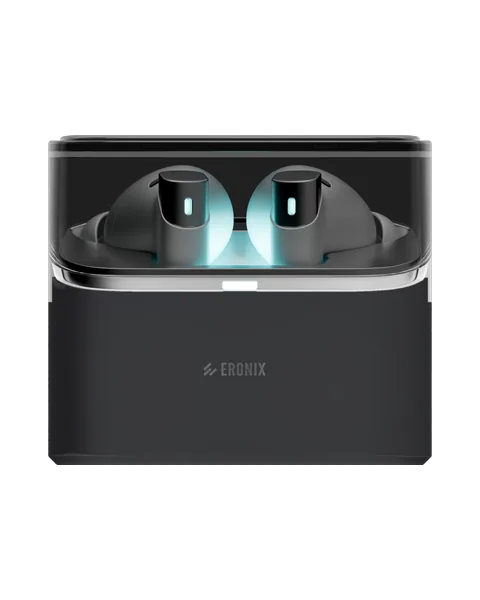
For the metro and the bus, the Euphoria earbuds seal the canal and add noise cancelling up to 45 dB, with aptX HD and 5.5 hours of playback.
For the road run, the Sirocco open-ear clips use directional drivers so traffic stays audible, with IP55 for sweat and rain and 8 hours in the earbuds, 32 more from the case.
Step by step
- Note where you listen most: commute, desk, travel or exercise.
- Choose in-ear for noisy commutes, over-ear for long sessions, open-ear for awareness.
- Try every tip size or wear the headphones for five minutes before buying.
- Check battery life with noise cancelling on.
- Check sweat and water ratings if you will exercise.
Questions people ask
Are open-ear earbuds bad for sound quality?
They trade bass and isolation for awareness. With no seal, low frequencies escape, and an AES paper shows even a tiny leak can cut bass at 50 Hz by about 15 dB. Open-ear designs suit podcasts, calls and outdoor exercise more than bass-heavy music in noisy places.
Do over-ear headphones block more noise than in-ear?
Passively, they are similar. Wikipedia's summary puts closed-back over-ear models at about 8 to 12 dB and sealed in-ear models at about 10 to 15 dB. With active noise cancelling, both shapes add 20 dB or more on low, steady noise. Fit decides more than shape.
Which headphones are safest for ears?
The ones that let you listen quietly. In noisy places that means good isolation or noise cancelling, so you do not raise the volume. The WHO advises keeping devices at or below 60% of maximum and lists 80 dB as safe for 40 hours a week. In traffic, open-ear designs keep you aware of surroundings.
Is bone conduction the same as open-ear?
Bone conduction is one kind of open-ear design. It passes vibration through the bones in front of the ear, leaving the canal open. Other open-ear earbuds use small speakers that sit outside the canal and send sound into it through the air. Both keep you aware; neither isolates.
Sources
- Headphones (Wikipedia) · accessed 22 Nov 2026
- AES E-Library: insert earphone leakage and bass response (abstract) · accessed 22 Nov 2026
- AirPods Pro technical specifications (Apple) · accessed 22 Nov 2026
- AirPods Max technical specifications (Apple) · accessed 22 Nov 2026
- AirPods 4 technical specifications (Apple) · accessed 22 Nov 2026
- Deafness and hearing loss: Safe listening (World Health Organization) · accessed 22 Nov 2026
Acoustics
What a driver actually does.
Read →Explainer · 5 min readThe 60/60 rule for listening
A rule of thumb you can follow without a meter, and the WHO numbers that stand behind it.
Read →Explainer · 5 min readWhat ANC can and cannot block
Why the bus engine fades but the conductor's voice does not, and what to check.
Read →Explainer · 4 min readTransparency mode: how earbuds let the world back in
Your earbuds can hear the platform announcement for you. Here is how, and where it stops.
Read →Explainer · 4 min readEarbuds for flights: what actually matters
The engine hum is the easy part. Fit, battery and volume decide how you land.
Read →Explainer · 4 min readSafe listening: how loud is too loud?
Hearing damage is a dose: loudness times time. Five decibels changes it a lot.
Read →