Journal · Explainer · 5 min read
Standards bodies that shape your charger: USB-IF, WPC, BIS
Three bodies decide whether a charger talks, charges wirelessly and can be sold here.
Turn over almost any charger and you find a small crowd of marks: a USB logo, perhaps a Qi symbol, and in India a BIS mark with a registration number. A non-member pays US$3,500 just for the right to print that USB logo, and only after passing compliance tests. So who writes these rules, and what does each mark actually promise?
Short answerMostly three bodies. The USB Implementers Forum writes the USB-C and USB Power Delivery specifications and runs their compliance testing. The Wireless Power Consortium writes Qi, the wireless charging standard. The Bureau of Indian Standards sets mandatory safety and registration rules for many electronics sold in India. Each mark answers a different question.
USB-IF: the rules for USB-C and Power Delivery
The USB Implementers Forum maintains the USB specifications, including USB Power Delivery, the protocol a charger and phone use to agree on voltage and current. Its charger page explains that Power Delivery now reaches up to 240 W over a full-featured USB-C cable, using fixed voltages of 28 V, 36 V and 48 V added in PD 3.1, where it previously stopped at 100 W.
Writing a specification is only half the job. The USB-IF's compliance programme checks real products against it. Its compliance page lists five routes to certification, including authorised independent test labs and members-only compliance workshops held roughly once a quarter and typically running five days. Products that pass join the USB-IF Integrators List.
Only then can a company use USB-IF logos. Its logo licence page says the logos may be used only with products that passed compliance testing, and requires a signed trademark licence and a USB vendor ID; non-members pay a US$3,500 logo administration fee.
| Body | Sets the rules for | What you can check |
|---|---|---|
| USB-IF | USB-C and USB Power Delivery | USB-IF Integrators List |
| WPC | Qi wireless charging | Qi product database |
| BIS | Safety for products sold in India | R-number on the CRS portal or BIS CARE app |
Source: USB-IF; Wireless Power Consortium; Bureau of Indian Standards, accessed 22 Nov 2026
Watts
Source: Wikipedia: Qi (standard), accessed 22 Nov 2026
WPC: the rules for Qi wireless charging
The Wireless Power Consortium is an open standards body administered by IEEE-ISTO, with a nine-member board elected by its members. It writes the Qi specification, which defines how a charging pad and a phone exchange power and control signals.
Qi has grown in steps. Wikipedia's summary lists 5 W in Qi 1.0 from 2010, 15 W with the Extended Power Profile in 2015, the magnet-aligned Qi2 in April 2023, and up to 25 W with Qi2.2 in April 2025, marketed as Qi2 25W from July 2025. The WPC says Qi2 25W gives nearly 70% more charging power than Qi2.
Certification is restricted. The WPC states that only its members can put products through Qi certification, using authorised independent test labs, and gives an average of 24 days for certification testing in 2026. Its public product database lets anyone check whether a charger actually passed certification.
BIS: the safety gate for India
The Bureau of Indian Standards is India's national standards body. Wikipedia records that its predecessor, the Indian Standards Institution, was founded on 6 January 1947, and that BIS took over on 1 April 1987 under the Bureau of Indian Standards Act, 1986. It writes Indian Standards, runs certification schemes and represents India at ISO and IEC.
For electronics, the key scheme is Compulsory Registration. Its Standard Mark is mandatory for certain electronics and IT goods. Each registered product carries a registration number, and the BIS CRS portal lets anyone search it by R-number. The BIS CARE app offers the same check on a phone.
How the three fit together
Think of a cricket match. The laws of the game are written once and shared by every team: that is USB-IF and WPC, making sure any charger and any phone play by the same rules. The umpires who check that a bat is legal before play begins are the test labs. And the stadium security who decide whether you are allowed in at all are BIS, checking that the product meets India's safety requirements before it is sold here.
None replaces the others. A charger can follow USB PD perfectly and still lack BIS registration, or carry a BIS number and never have been tested by USB-IF. Each mark tells you one specific thing.
There are other bodies in the background. The Bluetooth SIG writes the rules your earbuds use, and international bodies such as the IEC publish safety standards that national schemes build on. For a charger bought in India, though, these three are the ones whose marks you can check yourself.
What to check before you buy
Find the BIS registration number on the charger or power bank and look it up on the BIS CRS portal or BIS CARE app. The manufacturer name should match.
For wireless chargers, search the WPC's Qi product database for the model before trusting a Qi or Qi2 claim.
For USB logos, check that the logo matches the claim. A USB product that passed compliance testing should be findable on the USB-IF Integrators List.
Read the output ratings regardless of logos. Volts, amps and supported protocols tell you whether it suits your device.
Be wary of vague wording such as compatible with or supports Qi without a certification reference.
Myth corner
Myth: a BIS mark means the charger will fast-charge my phone. BIS registration concerns safety and conformity to Indian Standards. Whether a charger fast-charges your phone depends on protocols like USB Power Delivery and PPS, which are a separate question.
The right one for you
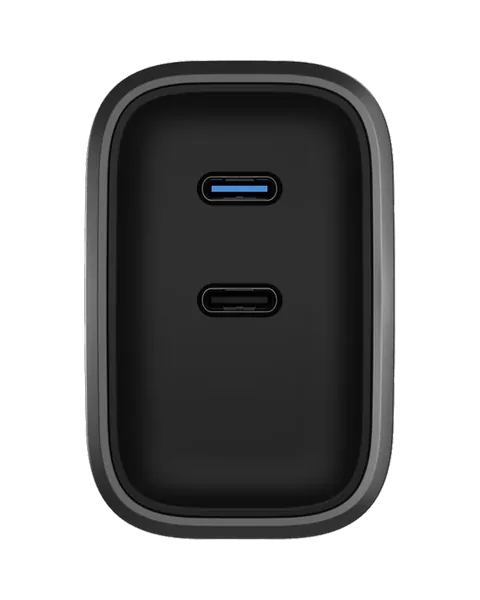
Marks tell you who checked a charger; the ratings tell you whether it suits your phone. The Fermi45 prints every rail it offers, from 5 V 3 A to 20 V 2.25 A, along with PPS from 5 to 20 V at 3 A and Samsung Super Fast Charging 2.0.
That is 45 W from one port for an iPhone 17 or a 45 W Galaxy S, in a GaN3 body that draws under 0.05 W when idle.
Step by step
- Read the BIS R-number on the charger and verify it on the BIS CRS portal or BIS CARE app.
- For wireless chargers, search the model in the WPC Qi product database.
- Check the USB-IF Integrators List if a USB logo is shown.
- Read the volts, amps and protocols on the label.
- Keep the bill and seller details for warranty.
Questions people ask
What does USB-IF certification mean?
It means the product passed the USB Implementers Forum's compliance testing against USB specifications and appears on its Integrators List. Only such products may use USB-IF logos under a trademark licence. It tells you the product meets the USB spec; it is not a substitute for India's BIS safety registration.
What does Qi certification mean?
A product with Qi certification has been tested at a WPC-authorised lab against the Qi specification, and only WPC members can certify products. You can confirm it in the WPC's public product database. Certification helps ensure the charger works safely and correctly with Qi phones and accessories.
How do I check a BIS number on a charger?
Find the R-number printed on the charger, power bank or box, then search it on the BIS CRS portal or in the BIS CARE app. The result should show the manufacturer and product category. If the number does not appear or the name does not match, avoid the product.
Is USB-C the same as USB Power Delivery?
No. USB-C is the connector and cable standard. USB Power Delivery is the charging protocol that runs over it, letting a charger and device agree on voltage and current up to 240 W. A USB-C charger may or may not support Power Delivery, so check the label.
Sources
- USB-IF: USB Charger (USB Power Delivery) · accessed 22 Nov 2026
- USB Implementers Forum: Compliance program · accessed 22 Nov 2026
- USB Implementers Forum: Logo license · accessed 22 Nov 2026
- Wireless Power Consortium: Knowledge base · accessed 22 Nov 2026
- Wikipedia: Qi (standard) · accessed 22 Nov 2026
- Wikipedia: Bureau of Indian Standards · accessed 22 Nov 2026
- Bureau of Indian Standards: Compulsory Registration Scheme portal · accessed 22 Nov 2026
USB-C Power Delivery
One connector, a negotiated contract.
Read →Buying guide · 4 min readWhich charger does the Pixel 10 Pro need?
Google sells the phone without a brick. Here is exactly which one to pair it with.
Read →Explainer · 5 min readThe history of the phone charger, 2007 to now
Two decades, a hundredfold jump in power, and finally one plug. The long read
Read →Explainer · 5 min readUSB Power Delivery explained in one page
How a charger and a phone agree on power before it flows, and how to read the label.
Read →Explainer · 5 min readPPS: why Samsung phones care about it
Three letters on a charger label decide whether a Galaxy charges at full speed or half.
Read →Explainer · 4 min readCan you use a Samsung charger on an iPhone?
Different logos, same plug, shared standard. What decides the speed is two letters: PD.
Read →