Journal · Explainer · 4 min read
Voltage fluctuation in India and your charger
Your charger is built for a far wider swing than your colony's evening dip.
The lights dim when the evening load peaks, the fan slows, and then the power comes back with a flicker. Meanwhile your phone sits on its charger. Many Indian households have learned to unplug everything at the first sign of trouble. Is the charger really at risk every time the voltage wobbles?
Short answerA well-made phone charger accepts any input from about 100 to 240 V, so everyday dips and rises on India's 230 V, 50 Hz supply are absorbed inside it and your phone sees a steady output. The real dangers are spikes from lightning or wiring faults, and heat. A surge-protected strip and a standards-compliant charger handle most of it.
The numbers: India's supply and your charger's range
WorldStandards lists India's mains supply as 230 V at 50 Hz, with Type D sockets for small appliances, rated 6 A, and Type M for heavy ones such as refrigerators and washing machines, rated 16 A. Type C plugs from imported devices often fit Type D sockets loosely, which it warns can make an unstable or unsafe connection.
Apple's support page states that its USB power adapters are designed for supplies of 100 V to 240 V AC at 50 to 60 Hz. That leaves a wide margin either side of India's nominal 230 V: the supply could fall by more than half before the adapter is outside its rated range.
Engineering references go further. The Wikipedia summary of switched-mode power supplies notes that universal-input designs commonly work from 90 to 250 V, and that supplies with active power-factor correction are typically auto-ranging from 90 to 264 V AC.
| Item | Voltage | Frequency |
|---|---|---|
| India mains supply | 230 V | 50 Hz |
| Apple USB power adapters (rated) | 100 to 240 V AC | 50 to 60 Hz |
| Universal-input power supplies | 90 to 250 V | — |
| Supplies with active PFC | 90 to 264 V AC | — |
Source: WorldStandards; Apple Support; Wikipedia, switched-mode power supply
How a charger absorbs fluctuations
A modern phone charger is a switched-mode power supply. It first turns the incoming AC into high-voltage DC, roughly 325 V for a 230 V design, and stores it in a filter capacitor. A fast switching circuit then chops that DC into pulses, passes them through a small transformer, and converts them back to the low voltage your phone asks for.
A feedback loop watches the output and adjusts how long each pulse lasts. If the mains drops, the pulses get longer; if it rises, they get shorter. The output stays steady, which is why your phone charges the same on a weak evening supply as at noon.
Think of a car's suspension on a rough road. The wheels move up and down over every pothole, but the cabin stays level because the springs and dampers soak up the motion. The charger's feedback loop is the suspension; the mains wobble is the road.
What actually damages chargers
Spikes are the main risk. A lightning strike nearby, a fault on the line or heavy motors switching can send a brief surge far above 240 V. Samsung India's warranty terms list lightning and abnormal voltage among causes not covered, which shows how seriously makers treat them.
Heat is the slow risk. The switched-mode power supply summary notes that failure rates roughly double for every 10 to 15 °C above 25 °C. A charger running hot in a closed drawer during an Indian summer ages faster than one in open air.
Loose contacts are the hidden risk. A plug that wobbles in its socket can spark and heat at the pins. That is a socket problem, not a voltage problem, but it is common in older homes.
Signs a charger has taken a hit
After a storm or a sudden power return, look at your chargers before you trust them again. A charger that is completely dead, buzzes or whines more than before, smells burnt, or shows scorch marks near the pins has likely been damaged. Stop using it.
A charger that works but now runs much hotter, or charges in fits and starts with a known-good cable, also deserves replacing. The parts that fail inside, such as filter capacitors and switching transistors, can fail in a way that passes more power through than intended, which is not a risk worth taking for the price of a new charger.
What to check before you buy
Read the input line on the charger. It should say 100 to 240 V, 50 or 60 Hz. A narrower range offers less headroom.
Check for a BIS Standard Mark with an R-number and verify it in the BIS CARE app. A registered charger has been tested against the applicable Indian Standard.
Use a surge-protected extension strip for chargers in homes with frequent spikes or storms. A voltage stabiliser is built for appliances such as refrigerators and air conditioners; a phone charger does not need one.
Make sure the plug fits the socket firmly. If a two-pin plug sits loose in a three-pin socket, fix the socket rather than wedging the plug.
Unplug chargers during thunderstorms if you have no surge protection.
Myth corner
Myth: low voltage damages a phone charger. Fact: a switched-mode charger compensates by changing its pulse width, and Apple rates its adapters down to 100 V. A dip below that may stop charging, but the steady fluctuations of an Indian evening are well within range.
The right one for you
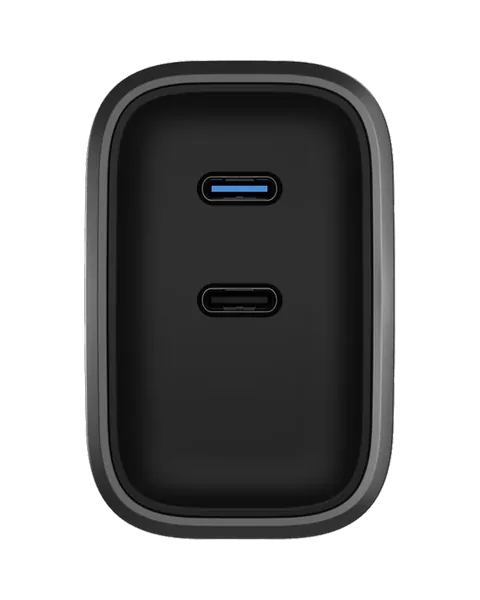
What this article asks of a charger is a wide input range and sensible protection. Fermi45's input reads 100–240 V, 50–60 Hz, and it lists over-voltage, over-current, over-temperature and short-circuit protection on a GaN3 power stage.
It is matched to the iPhone 17 series and the Galaxy phones that take 45 W. Where storms are common, give it a surge-protected strip as well.
Step by step
- Check the charger's input reads 100 to 240 V, 50 or 60 Hz.
- Verify its BIS R-number in the BIS CARE app.
- Plug it into a surge-protected strip in storm-prone areas.
- Make sure the plug sits firmly in the socket.
- Keep the charger in open air, not in a closed drawer.
Questions people ask
What does 100-240V on a charger mean?
It means the charger accepts any mains voltage from 100 to 240 V. Apple states this range, at 50 to 60 Hz, for its USB adapters. India's supply is 230 V at 50 Hz, so these chargers work here and abroad without a converter, only a plug adapter where sockets differ.
Do I need a stabiliser for my phone charger?
No. Phone chargers are switched-mode supplies that regulate their own output across a wide input range, commonly 90 to 250 V. A stabiliser is meant for appliances like refrigerators and air conditioners. For chargers, a surge-protected strip is the more useful protection against spikes.
Can a power cut damage my phone while charging?
A normal cut simply stops charging. The risk comes when power returns with a surge, or from lightning on the line. A charger that meets safety standards, plugged into a surge-protected strip, handles most situations. The phone's own charging circuit adds another layer of protection.
Why does my phone charge slowly during low voltage?
A healthy charger should deliver the same output even when the mains dips, because its feedback loop compensates. Slow charging usually points elsewhere: heat, a worn cable, a loose plug, or the phone itself limiting speed. Try another cable and a cooler spot first.
Sources
- WorldStandards: India plug, socket and voltage · accessed 22 Nov 2026
- Apple Support: About Apple USB power adapters · accessed 22 Nov 2026
- Wikipedia: Switched-mode power supply · accessed 22 Nov 2026
- Samsung India: Warranty information · accessed 22 Nov 2026
- BIS CARE app (Google Play) · accessed 22 Nov 2026
Thermal Management
The quiet discipline inside every serious power product.
Read →Explainer · 4 min readDoes fast charging kill the battery?
The watts on the charger matter less than the temperature of the phone
Read →Explainer · 5 min readSilicon carbide and GaN: the next step in chargers
A new label is reaching charger boxes. What silicon carbide does, and does not, change.
Read →Explainer · 4 min readHotel room charging: making one socket work
One socket behind the bed, three devices, a 7 am meeting. Here is the plan.
Read →Explainer · 5 min readGaN chargers: what changed and what did not
A new material shrank the charger. Your phone's charging speed stayed where it was.
Read →Comparison · 4 min readGaN vs silicon chargers in daily use
Side by side on a desk, in a bag and on the electricity bill. One number decides it.
Read →