Journal · Explainer · 5 min read
Why charging speed claims differ from lab tests
Both numbers are honest. They are answers to slightly different questions.
The brand says 50% in 20 minutes. A lab says 19 minutes. A friend times it at home and gets 27. Another review says the phone never passes 36 W. Is someone lying, or are they all measuring something different?
Short answerThey are measuring different things. Claims and tests differ on the starting battery level, the room temperature, where the power is measured, which charger and cable are used, and software settings. Each can be accurate for its conditions. The habit to keep: compare minutes to 50% from a low start, at room temperature, on the charger the brand names.
Same phone, different numbers
Apple's fast-charge page says the iPhone 17 models reach up to 50% in about 20 minutes with a 40 W or higher adapter. Its small print explains the method: phones are drained first, and timing starts when the Apple logo appears.
ChargerLAB's test of the iPhone 17, reported by Notebookcheck, ran in a thermal chamber held at 25°C, logging power with a POWER-Z USB tester. With a 40 W adapter it measured 19 minutes to 50%, 44 minutes to 80% and about 1 hour 42 minutes to full. With a 20 W adapter, the figures were 27 minutes, 52 minutes and 1 hour 50 minutes. Above 40 W, the 70 W and 140 W adapters produced nearly identical curves.
MacRumors, reporting ChargerLAB's separate test of the iPhone 17 Pro Max, gave the peak instead: about 36 W across every Apple charger from 40 W to 140 W, against about 30 W for the iPhone 16 Pro Max. A peak in watts and a time to 50% describe the same charge in two different ways.
Full charge times can make chargers look identical. ChargerLAB's comparison of the iPhone 16 Pro found full charges between 1 hour 59 minutes and 2 hours 6 minutes with every Apple charger from 20 W to 140 W, at 25°C. Most of the difference between chargers sits in the first half, not the last.
| Adapter | To 50% | To 80% | To 100% |
|---|---|---|---|
| 20 W | 27 min | 52 min | 1 h 50 min |
| 40 W | 19 min | 44 min | about 1 h 42 min |
Source: ChargerLAB via Notebookcheck, 2025
Minutes
To 50% To 80%
Source: ChargerLAB via Notebookcheck, 2025
The six things that change the result
Starting point. A phone accepts the most power near empty. A test from 0% will beat one from 20%, and Apple's timing from the Apple logo also skips the first moments of a dead phone.
Temperature. Labs often hold 25°C. An Indian room in May can be far warmer, and Battery University recommends 5°C to 45°C for fast charging, with the best results between 10°C and 30°C. A warm phone cuts current earlier.
Where power is measured. Testers usually read power at the USB cable, after the charger. Wall-socket meters read higher, because they include the charger's own conversion losses, and the phone's own battery readout is different again. A figure means little until you know which point it came from.
Charger and cable. The protocol matters more than the watts. A charger without the phone's preferred profile, or a cable that cannot carry the current, lowers the result.
Software. Features such as optimised or adaptive charging can hold at 80% for a while. ChargerLAB suggests keeping Apple's Optimized Battery Charging on to avoid overcharging, and that feature can make a home test look slower near the top.
Use. A phone that is streaming video or downloading updates while charging spends part of the power on itself.
How a lab test works
A test lab places the phone in a temperature-controlled chamber, connects it through a USB power tester that logs voltage and current many times a second, and records the battery percentage over time. The screen is usually off and the phone idle. The result is a curve: watts and percentage against minutes.
It is like the mileage figure printed in a new car's brochure. It comes from a standard drive cycle on a test rig, so every car is compared on the same terms. Your own mileage in Kolkata traffic in June will differ, but the brochure figure still tells you which car is more efficient.
Good labs also say what they did. A trustworthy test names the charger, the cable, the room or chamber temperature and the tester used, and shows the whole curve rather than one number. If a review gives only a peak wattage with no conditions, treat it as a headline rather than a measurement.
What to check before you buy
Find the brand's time claim and the exact charger it names. For an iPhone 17, that means an adapter of 40 W or more.
Find an independent lab test that states its temperature and equipment, and compare minutes to 50%.
Check whether a bigger charger changes the lab curve. If 40 W and 140 W curves match, the extra watts add nothing for that phone.
Test at home within the return window from a low battery, screen off, in a cool room.
Use the cable that came with the phone, or one rated for the phone's current.
Myth corner
Myth: if my result is slower than the claim, my charger is faulty. Heat, a higher starting level, phone use or an 80% hold all slow a home test. Repeat it at about 25°C from a low battery with the screen off before suspecting the charger.
The right one for you
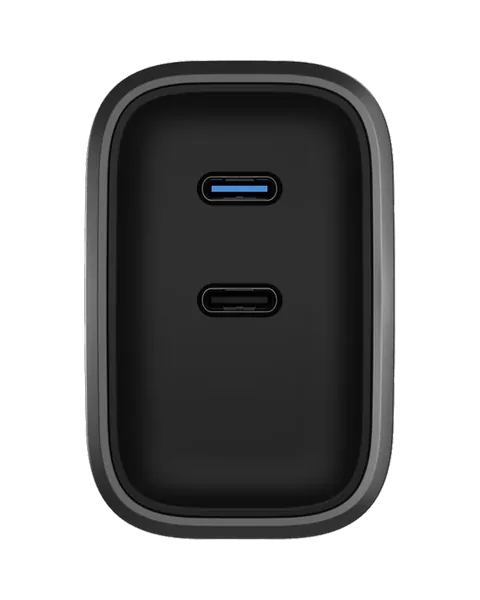
Every lab number above points to one threshold for the iPhone 17: Apple names 40 W or more for its fastest wired charge, and ChargerLAB found nothing further to gain above it. The Fermi45 sits just over that line, with 45 W, PPS and a GaN3 power stage, and it is matched to the iPhone 17 series. A second USB-C port and a body of 62.5 × 42 × 36 mm make it the one charger the bedside socket needs.
Step by step
- Start from a low battery, around 10%.
- Use the charger and cable the brand names.
- Charge in a cool room with the screen off and no case.
- Note the percentage at 10, 20 and 30 minutes.
- Compare your minutes to 50% with the claim and a lab test.
Questions people ask
Why is my phone slower to charge than the advert says?
Adverts usually describe a drained phone, at room temperature, on a specific charger and cable, idle. Starting higher, a warm room, a different charger, using the phone or an 80% hold all add minutes. Recreate those conditions before judging the charger or phone.
How do labs like ChargerLAB test charging?
They keep the phone at a controlled temperature, often 25°C, connect it through a USB power tester that logs voltage and current, and record battery percentage over time with the phone idle. That gives a curve showing peak watts, how long the peak lasts and minutes to each percentage.
Is peak watts or time to 50% more important?
Time to 50% is more useful. The peak may last only a minute or two, while minutes to 50% include the taper. ChargerLAB measured the iPhone 17 at 19 minutes to 50% on a 40 W adapter, a figure you can compare directly with Apple's claim of about 20 minutes.
Why do wall meters show higher watts than phone tests?
A wall meter measures power entering the charger, which includes the charger's own conversion losses. USB testers measure power leaving the charger through the cable. The phone-side reading is lower and is the better guide to how fast the battery fills.
Sources
- Apple Support: Fast charge your iPhone · accessed 22 Nov 2026
- Notebookcheck: iPhone 17 charging test shows negligible improvement with Apple's new 40 W charger · accessed 22 Nov 2026
- MacRumors: iPhone 17 Pro Max's USB-C charging speeds tested with Apple chargers · 22 Sep 2025
- ChargerLAB: Comparative test of iPhone 16 Pro with Apple chargers at different power · accessed 22 Nov 2026
- ChargerLAB: Up to 40W? Charging review of iPhone 16 · accessed 22 Nov 2026
- Battery University: BU-410 Charging at high and low temperatures · accessed 22 Nov 2026
Super Fast Charging and Super Fast Charging 2.0
What Galaxy asks of a charger, and how PPS answers it.
Read →Explainer · 4 min readDoes fast charging kill the battery?
The watts on the charger matter less than the temperature of the phone
Read →Explainer · 4 min readHow to charge a phone fast before a flight
Thirty minutes at the gate can be worth half a battery. Five steps to get it.
Read →Explainer · 5 min readPPS: why Samsung phones care about it
Three letters on a charger label decide whether a Galaxy charges at full speed or half.
Read →Explainer · 4 min readWhy your phone charges fast to 50% and slow after 80%
The slowdown is not your charger failing. It is the battery asking to be treated gently.
Read →Explainer · 4 min readDo original chargers matter?
The logo on the plug matters less than two words in its small print.
Read →