Journal · Explainer · 4 min read
Podcasts and audiobooks: earbuds that suit long listening
Music forgives a lot. A six-hour audiobook exposes every pressure point and lost word.
A single audiobook can run 20 hours, longer than a week of commutes. Add podcasts on the train and stories at bedtime, and spoken word can fill more hours than music ever did. Earbuds that sound great on a three-minute song can feel tiring by the second chapter. What actually matters for long spoken-word listening?
Short answerComfort first, then clear voices, then battery, then hearing safety. Choose earbuds that fit without pressure, keep the midrange clear so voices stay intelligible at low volume, and last 6 to 8 hours per charge. Use noise cancelling or a good seal to keep volume down; the WHO counts 80 dB as safe for 40 hours a week.
The numbers for a long listening day
Hearing safety is about dose. The World Health Organization's safe listening guidance treats 80 dB as safe for up to 40 hours a week and 85 dB for about 12.5 hours. A 20-hour audiobook at a moderate level sits comfortably inside the budget; the same book at loud commute volume does not. The WHO also suggests keeping device volume at or below 60% of maximum and notes that well-fitted noise-cancelling headphones reduce the need to raise volume.
Battery per charge matters more than the case total. Apple rates AirPods Pro at up to 8 hours with noise cancelling on, and Samsung rates the Galaxy Buds3 FE at up to 6 hours with ANC on and 8.5 hours with it off. A long train journey fits in one charge on most current designs; a full day does not.
Voices sit in a forgiving part of the spectrum. Wikipedia's summary of the ISO 226 equal-loudness contours notes that hearing is most sensitive between about 2 and 5 kHz, which is where much of the consonant detail in speech lives. A clear midrange lets you follow every word at a lower level than music would need.
| Level or setting | Safe allowance |
|---|---|
| 80 dB | Up to 40 h a week |
| 85 dB | About 12.5 h a week |
| Device volume | At or below 60% of maximum |
Source: World Health Organization, accessed 22 Nov 2026
Why spoken word is different from music
Music is redundant: if you miss a beat, the next bar repeats it. Speech is not: if you miss a word, the sentence loses meaning and you rewind. So the earbud's job for spoken word is clarity at low volume, not deep bass or sparkle.
Comfort is the other half. Apple's fit guide suggests wearing earbuds for 10 to 15 minutes during normal activity to judge a tip size, and trying a different size if the tips feel loose or fall out, or feel compressed and uncomfortable. For audiobooks, test longer: pressure that is unnoticeable after five minutes can ache after two hours.
Think of the difference between a pair of party shoes and a pair of walking shoes. Both look good in the shop. Only one is still comfortable on the tenth kilometre. Long-listening earbuds are walking shoes.
Tuning matters in a quieter way too. Many earbuds are tuned with extra bass for music. That bass can make a narrator's voice sound boomy and tiring over hours. A balanced sound, or an equaliser preset that trims the low end and lifts the vocal range slightly, can make long spoken-word sessions easier.
Features that help long listening
Conversation Awareness and similar features. Apple says that with Conversation Awareness, media volume drops when you start speaking, spoken media such as a podcast pauses after a few seconds, and playback returns when the conversation ends. For podcasts, that saves endless rewinding.
Personalised volume and listening profiles. Apple's Personalized Volume adjusts media volume to your surroundings over time, and many apps offer similar automatic level control.
One-earbud listening. Some designs allow noise cancelling with a single bud; Apple offers it as an accessibility setting on AirPods 4 with ANC and AirPods Pro. Alternating buds can stretch battery and rest each ear.
Sleep timers. For bedtime stories, the sleep timer in most podcast and audiobook apps stops playback on its own, on any earbuds, so you do not wake to a book that played on for three chapters. Apple's AirPods settings also offer Pause Media When Falling Asleep on recent models.
Playback speed is a feature too, though it lives in the app, not the earbuds. Many listeners speed podcasts up. Faster speech packs consonants closer together, so clarity in the vocal range matters even more at 1.5 times speed than at normal pace.
What to check before you buy
Wear them for at least 15 minutes in the shop or at home within the return window, and notice any pressure on the outer ear.
Listen to a podcast at low volume, not a song at high volume. Every word should be clear without turning up.
Check the single-charge battery figure with your usual noise mode, not the case total.
Check for auto-pause features, a sleep timer option and quick-charge claims.
Check weight and shape if you lie on your side while listening.
Myth corner
Myth: spoken word is quiet, so it cannot harm hearing. On a noisy commute people often push podcasts as loud as music. The WHO dose limits apply to any sound. Keep volume moderate and use noise control so voices stay clear without raising the level.
The right one for you
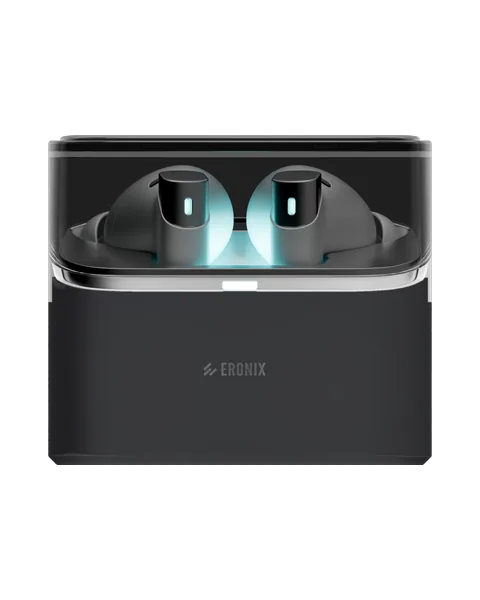
For long listening, quiet matters as much as sound: noise cancelling lets a narrator stay clear at the low volume the WHO advises. The Euphoria brings 45 dB noise cancelling to iPhone and Galaxy S, with 5.5 hours of playback on a charge.
Step by step
- Try each tip size and wear the best fit for at least 15 minutes.
- Test clarity with a podcast at low volume.
- Set a volume ceiling around 60% of maximum.
- Use ANC or a good seal on noisy commutes.
- Take a short break every hour and use a sleep timer at night.
Questions people ask
How long can I safely listen to audiobooks with earbuds?
It depends on volume. The WHO treats 80 dB as safe for up to 40 hours a week, but only about 12.5 hours at 85 dB and 4 hours at 90 dB. Keep device volume at or below 60% of maximum, take breaks, and use noise control so you do not need to turn it up.
Are earbuds or headphones better for long podcasts?
Either can work. Over-ear headphones avoid ear-canal pressure but can feel warm; earbuds are lighter and easier in bed or on a commute. Choose whichever fits you without pressure after an hour. A good seal or ANC matters for both, because it keeps volume lower.
Why do my ears hurt after long earbud use?
Usually the tip size or shape is wrong, or the bud presses on the outer ear. Apple's fit guide says to try a different size if tips feel compressed or uncomfortable, and notes each ear may need a different size. Take breaks, alternate ears for spoken word and clean tips regularly. See a doctor about persistent pain.
Do I need ANC for podcasts?
Not always, but it helps on noisy commutes. With background noise reduced, voices stay clear at lower volume, which is easier on hearing over long sessions. In a quiet home, a good passive seal is enough, and turning ANC off extends battery.
Sources
- World Health Organization: Deafness and hearing loss, safe listening (Q&A) · accessed 22 Nov 2026
- Apple: AirPods Pro technical specifications · accessed 22 Nov 2026
- Samsung Newsroom US: Samsung introduces Galaxy Buds3 FE · accessed 22 Nov 2026
- Wikipedia: Equal-loudness contour (ISO 226) · accessed 22 Nov 2026
- Apple AirPods User Guide: Find the right fit with AirPods Pro · accessed 22 Nov 2026
- Apple AirPods User Guide: Adjust listening mode settings · accessed 22 Nov 2026
- Apple AirPods User Guide: Change settings for AirPods or AirPods Pro · accessed 22 Nov 2026
Acoustics
What a driver actually does.
Read →Explainer · 5 min readThe 60/60 rule for listening
A rule of thumb you can follow without a meter, and the WHO numbers that stand behind it.
Read →Explainer · 5 min readWhat ANC can and cannot block
Why the bus engine fades but the conductor's voice does not, and what to check.
Read →Explainer · 4 min readEarbuds for flights: what actually matters
The engine hum is the easy part. Fit, battery and volume decide how you land.
Read →Explainer · 4 min readSafe listening: how loud is too loud?
Hearing damage is a dose: loudness times time. Five decibels changes it a lot.
Read →Explainer · 4 min readOver-ear vs in-ear vs open-ear
Three ways to put sound near your ear, and each one trades something you will notice.
Read →